Use Six Hats Method
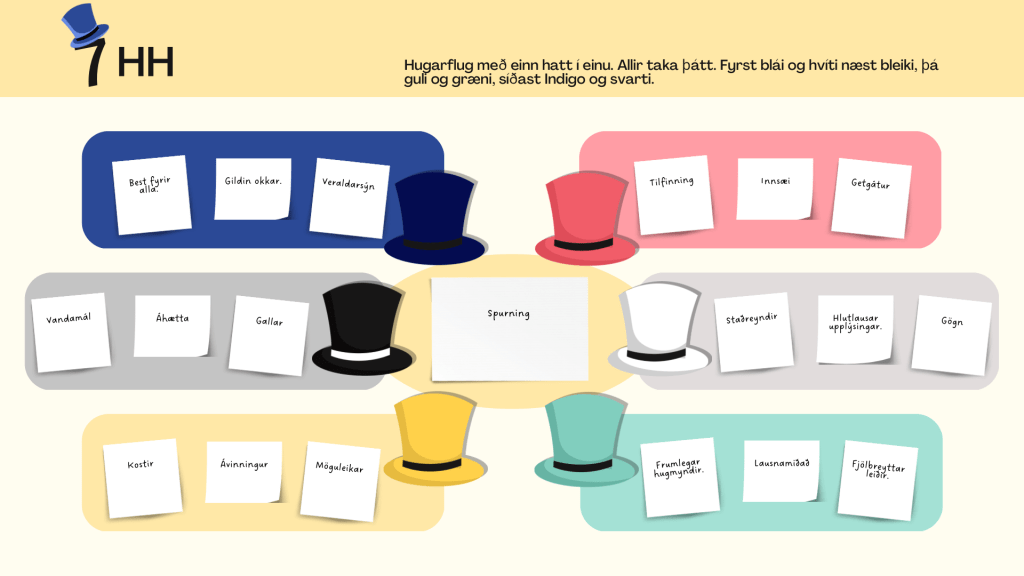
The Six Thinking Hats is a structured thinking and discussion technique created by Edward de Bono. It helps individuals and teams look at a problem from multiple perspectives—one at a time—so discussions are clearer, more balanced, and more productive.
Here’s a clear overview:
🎩 The Six Hats and What They Represent
White Hat – Facts & Information
Focus on data, facts, and what is known or missing.
Questions: What do we know? What data do we need?
Red Hat – Feelings & Intuition
Express emotions, gut feelings, and instincts without justification.
Questions: How do I feel about this? What’s my instinctive reaction?
Black Hat – Caution & Risks
Look for problems, weaknesses, and potential negative outcomes.
Questions: What could go wrong? What are the risks?
Yellow Hat – Benefits & Positives
Explore value, benefits, and optimistic outcomes.
Questions: What are the advantages? Why might this work well?
Green Hat – Creativity & Alternatives
Generate new ideas, possibilities, and creative solutions.
Questions: What else could we do? Are there alternative approaches?
Blue Hat – Process & Control
Manage the thinking process itself (agenda, summaries, next steps).
Questions: What’s our objective? What’s the next step?
✅ Why it’s useful
Reduces unproductive arguments
Encourages balanced thinking
Makes meetings more efficient
Separates emotion from logic
Boosts creativity and clarity
🧠 How it’s typically used
In meetings or workshops, everyone “wears” the same hat at the same time
Hats can be used in sequence (e.g. Blue → White → Green → Black → Yellow → Red → Blue)
Can also be used individually for decision-making or writing
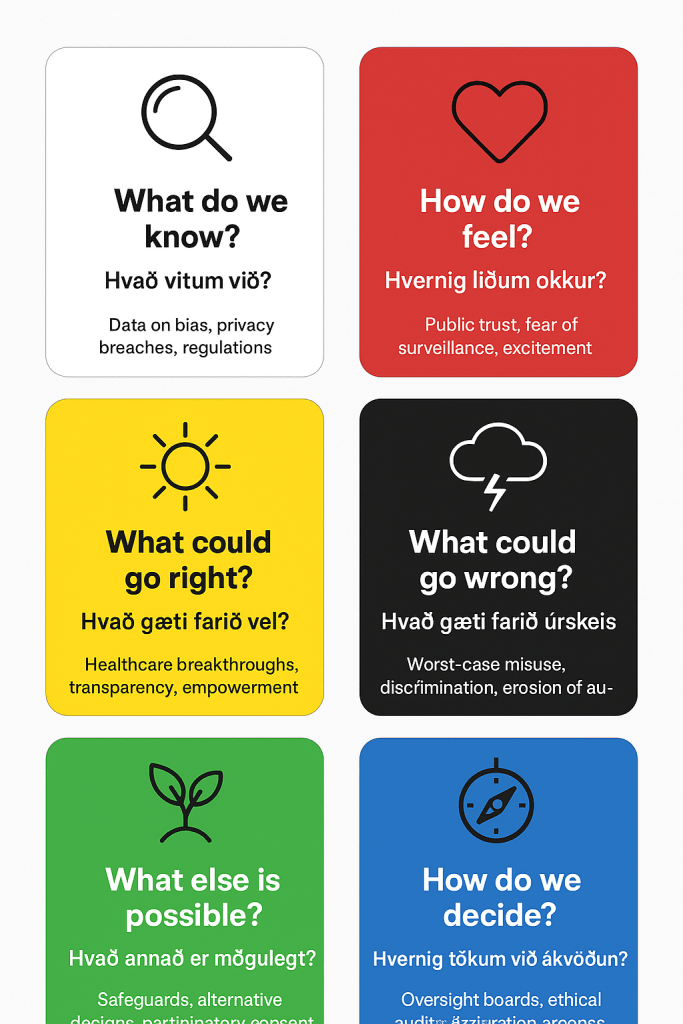
Here’s a simple, practical Six Thinking Hats meeting template you can copy and use straight away.
Six Thinking Hats – Simple Meeting Template
Meeting topic / decision:
Date & time:
Facilitator (Blue Hat):
Participants:
1. Blue Hat – Set the Frame (5 minutes)
Purpose of the meeting:
What decision, problem, or idea are we focusing on?
Success looks like:
(e.g. a clear decision, shortlist of options, agreed next steps)
Hat sequence to be used:
Blue → White → Green → Black → Yellow → Red → Blue
2. White Hat – Facts & Information (10 minutes)
What we know (facts, data, constraints):
What is missing or unclear:
Assumptions being made:
3. Green Hat – Ideas & Possibilities (10–15 minutes)
Ideas, options, alternatives (no judgement):
Improvements or variations:
4. Black Hat – Risks & Concerns (10 minutes)
What could go wrong:
Weaknesses, costs, or barriers:
5. Yellow Hat – Benefits & Value (10 minutes)
Advantages and positives:
Why this could work:
6. Red Hat – Feelings & Intuition (5 minutes)
Gut reactions and emotions (no explanations needed):
Overall comfort level: ☐ High ☐ Medium ☐ Low
7. Blue Hat – Summary & Next Steps (5 minutes)
Key insights:
Decision or outcome:
Next steps (who / what / by when):
Tips for Use
Everyone uses the same hat at the same time
The facilitator keeps the group on the current hat
Park off‑topic comments until the relevant hat
Add Hats if necessary
Here the Orange Hat for reflection:
Here’s a short, practical Orange Hat checklist you can use at the end of a meeting or activity.
🟠 Orange Hat – Reflection Checklist
Purpose: Pause, reflect, and capture learning.
☐ What worked well and should we repeat?
☐ What didn’t work as intended?
☐ What surprised us?
☐ What did we learn (about the issue, process, or team)?
☐ What would we do differently next time?
☐ One concrete improvement to apply next time:
Key takeaway (one sentence):
You can combine the orange hat with the blue hat for the meeting summary:
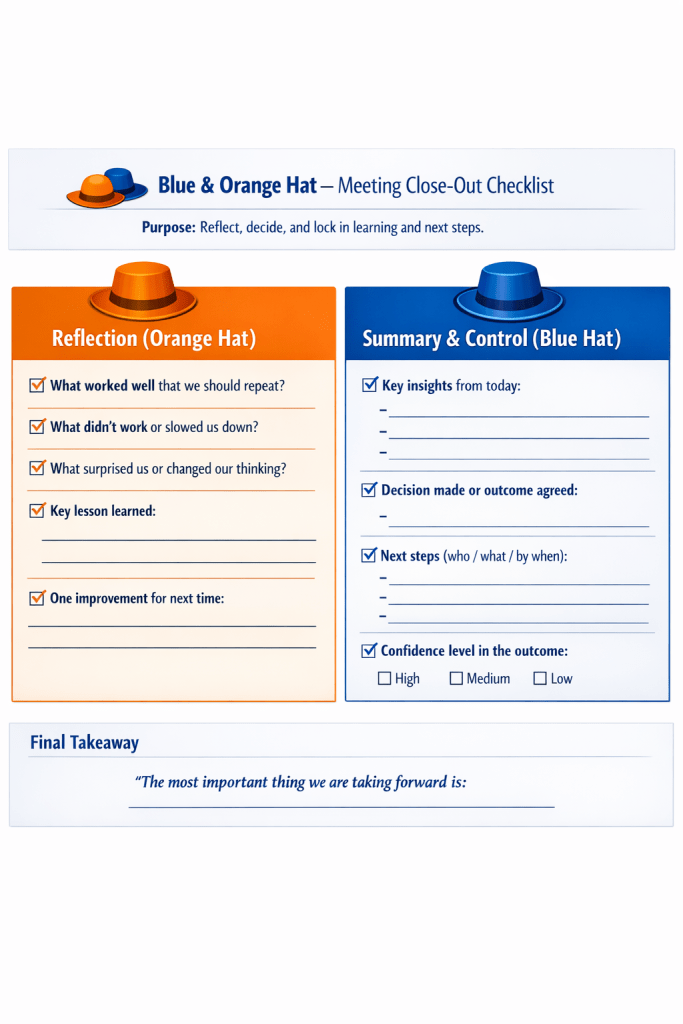
Here is a combined Orange Hat (Reflection) + Blue Hat (Summary) close‑out checklist you can use as a single, clean ending to any meeting.
🔵🟠 Blue & Orange Hat – Meeting Close‑Out Checklist
Purpose: Reflect, decide, and lock in learning and next steps.
Reflection (Orange Hat)
☐ What worked well that we should repeat?
☐ What didn’t work or slowed us down?
☐ What surprised us or changed our thinking?
☐ Key lesson learned (process, people, or decision):
☐ One improvement to apply next time:
Summary & Control (Blue Hat)
☐ Key insights from today (1–3 points):
☐ Decision made or outcome agreed:
☐ Next steps (who / what / by when):
☐ Confidence level in the outcome:
☐ High ☐ Medium ☐ Low
Final Takeaway (one sentence)
“The most important thing we are taking forward is:”
Bjorg Eggerts + 😻
bjorg@7hh.is


You must be logged in to post a comment.