Presentation – Integral Mindset by Guðbjörg Eggertsdóttir
AQAL All Quadrants and all levels
Presentation – Integral Theory Overview by Guðbjörg Eggertsdóttir
Presentation – Integral Theory Framework by Guðbjörg Eggertsdóttir
Integrate systems, culture and individuals
Presentation – Seeing the Whole Picture by Guðbjörg Eggertsdóttir
AQAL, All Quadrants and All Levels, is a meta-theory. It provides a comprehensive framework for understanding the complex dynamics of human experience and development. At its core, AQAL recognizes that reality is multi-dimensional. We can view and make sense of the world through multiple perspectives.
One of the key insights of AQAL is the recognition that our individual experiences are not isolated. They are not independent from each other. Instead, they are interconnected and influenced by various factors, such as our biological makeup, cultural background, and social relationships. This perspective encourages us to adopt a holistic view. It helps us understand human behavior. We appreciate the interplay between different aspects of our lives.
Moreover, AQAL emphasizes the importance of developmental stages and levels of consciousness. According to this meta-theory, human development is not a linear process. It is a progression through various stages. Each stage is characterized by distinct capacities and ways of seeing the world. This understanding helps us appreciate human complexity and diversity. It fosters a compassionate and inclusive approach to relationships with others.
In conclusion, AQAL provides a powerful lens. We can explore the intricate connections between individual, interpersonal, and collective dimensions of human existence using it. We recognize and embrace the complexity of our experience. This process allows us to gain a deeper understanding of ourselves and the world around us. It ultimately leads to personal growth and social transformation.
Ken Wilber, a philosopher and writer, has significantly contributed to integral theory and spiritual philosophy. His work explores the relationship between consciousness, spirituality, and personal development. Wilber’s ideas have influenced numerous fields, including psychology, sociology, and environmental studies.
In his writings, Wilber promotes the concept of a holistic approach to understanding reality, integrating various perspectives and dimensions. By synthesizing different theories and methodologies, he offers a comprehensive framework for grasping the complexity of the human experience.
Moreover, Wilber’s emphasis on the importance of individual growth and transformation has resonated with many readers. He encourages individuals to explore their potential and strive for personal evolution, all while considering the inter-connection of all life.
In conclusion, Ken Wilber’s work as a philosopher and writer has left a lasting impact. He has influenced the fields of spirituality, philosophy, and personal development. His approach is comprehensive and integrative. He has provided invaluable insights that continue to inspire individuals. These insights guide those seeking a deeper understanding of the human experience.
The AQAL model is a comprehensive framework developed by Ken Wilber, integrating various perspectives and dimensions of human experience. At its core, the model proposes that all phenomena can be understood in four distinct ways. These are the interior and exterior dimensions of both individual and collective realities. This holistic approach offers a more nuanced understanding of complex issues. It provides a valuable tool for mapping and navigating the intricate terrain of human consciousness.
Expanding upon the AQAL model, the interior dimension focuses on subjective experiences such as thoughts, emotions, and intentions. In contrast, the exterior dimension considers the observable and measurable aspects of behavior and systems. By recognizing individual and collective perspectives, the model encourages a more inclusive understanding of human development and societal progress.
Moreover, the AQAL model highlights the importance of embracing diversity and fostering integration. It emphasizes the interconnections between different perspectives. It draws attention to the need for empathy and compassion in creating a more harmonious and sustainable world. By acknowledging the complexity and interdependence of all aspects of reality, we can transcend limited views. The AQAL model invites us to engage in more holistic and inclusive ways of thinking and being.
In summary, the AQAL model offers a comprehensive framework for understanding and navigating the complexities of human experience. Integrating different dimensions provides a valuable tool for personal growth and social change. It also fosters a more interconnected and compassionate world.
The AQAL system perspective offers a comprehensive framework for understanding reality, integrating multiple dimensions of human experience. It offers a lens for exploring the interconnections between individual consciousness and collective systems. It also helps us understand the evolution of human society. This holistic approach considers four major dimensions. These include quadrants (individual and collective). They also cover levels of development, lines of development, and states of consciousness. By encompassing these dimensions, the AQAL system perspective provides insights. It allows us a more nuanced understanding of ourselves. It also helps us comprehend the world around us.
In the realm of personal growth and self-development, the AQAL system perspective provides a valuable tool. It helps us map out our journey. It acknowledges that we develop along multiple lines. These include cognitive, moral, emotional, and interpersonal aspects, which often progress at different rates. By acknowledging different lines of development, we can work towards a balanced and integrated self. This approach promotes growth in all dimensions of our being.
On a larger scale, the AQAL system perspective allows us to grasp the complexities of collective systems and societal evolution. It highlights the importance of individual and collective dimensions affecting one another. Both exert influence. This lens of analysis enables us to explore the various stages of societal development and the dynamics of cultural evolution. By understanding these broader patterns, we can gain insight into the challenges our communities face. We can also discover possibilities. This understanding helps us in creating a more inclusive and sustainable future.
The meta-theory has four quadrants and levels or stages of development. These stages are vertical. The lines of development grow through these stages. Typologies are horizontal.
(Typologies are organized systems of types or categories, used to classify and analyze entities or phenomena based on shared characteristics.)
AQAL individual exterior quadrant is for our behavior patterns and health. The exterior quadrant focuses on the physical aspects of our behavior and how it affects our overall well-being. It considers the external factors that influence our actions, such as our environment, social interactions, and daily habits.
By examining the exterior quadrant, we can gain insights into our behavioral patterns. We can also identify any areas that may require attention or improvement. For example, it sheds light on how our lifestyle choices or external stressors impact our health and well-being.
We can understand how our behavior patterns and health are interconnected. This helps us make informed decisions. These choices promote positive changes in our lives. This holistic approach recognizes that our actions are influenced by a complex web of factors. It highlights the importance of addressing the exterior quadrant to actively promote our overall well-being.

The collective we interior quadrant is our collective being. Our culture and patterns.
Our collective being is a reflection of our shared values and beliefs. It defines the essence of our community. Our shared experiences and aspirations weave us together. In this interior quadrant, we find a sense of unity and common purpose that transcends individuality. It is a space where our unique perspectives merge, creating a tapestry of diversity and growth.
Within this collective being, our culture thrives. It is the expression of our shared experiences, traditions, and customs that shape our identity. Our culture binds us together, providing a framework for how we interact, communicate, and understand the world around us. It is through our culture that we pass down our stories. We pass down our values and heritage to future generations. This ensures the continuity of our collective being.
Patterns emerge within our collective being, revealing the inter-connection of our thoughts and actions. These patterns serve as a compass, guiding us towards shared goals and visions. They provide a framework for collaboration, innovation, and progress. By recognizing these patterns, we can harness our collective power. This helps foster greater harmony and collaboration. Together, we can shape a future that reflects the best of our collective aspirations and potential.

The Collective exterior quadrant is the systems, networks and institutions. It represents the external framework that supports the development and functioning of the Collective. Within this quadrant, various interconnected systems and networks collaborate to ensure the smooth operation of the Collective. Institutions play a crucial role. They provide governance and oversight. This ensures that the Collective functions in a fair and equitable manner. These institutions establish rules and regulations. These guidelines direct the activities of the Collective. This promotes a sense of order and structure. The systems and networks within this quadrant work together. They ensure the efficient flow of information, resources, and decision-making processes. This coordination enables the Collective to function effectively.
The systems and networks in development have been crucial in shaping the modern technological landscape. With each passing day, advancements in these areas bring about new possibilities and opportunities for businesses and individuals alike. The constant drive for innovation pushes boundaries, enabling us to reach new heights in connectivity, efficiency, and productivity.
As these systems and networks continue to evolve, challenges arise that need to be addressed. Scalability and security are two primary concerns that organizations must consider. Ensuring the stability and resilience of these infrastructures is essential to meet the ever-growing demands of a digital world. With the increasing interconnectedness of devices and data, safeguarding against cyber threats is paramount.
Collaboration is also a key factor in the success of these systems and networks. Partnerships between organizations with complementary expertise can foster groundbreaking solutions and drive progress across industries. By joining forces, businesses can leverage their strengths. They can combine their resources to tackle complex problems more efficiently. This ultimately benefits society as a whole.
In conclusion, the development of systems and networks plays a pivotal role in shaping our technological future. Continual innovation is crucial. Implementing security measures is equally important. Collaborative efforts ensure the integrity and effectiveness of these essential components of our digital society.

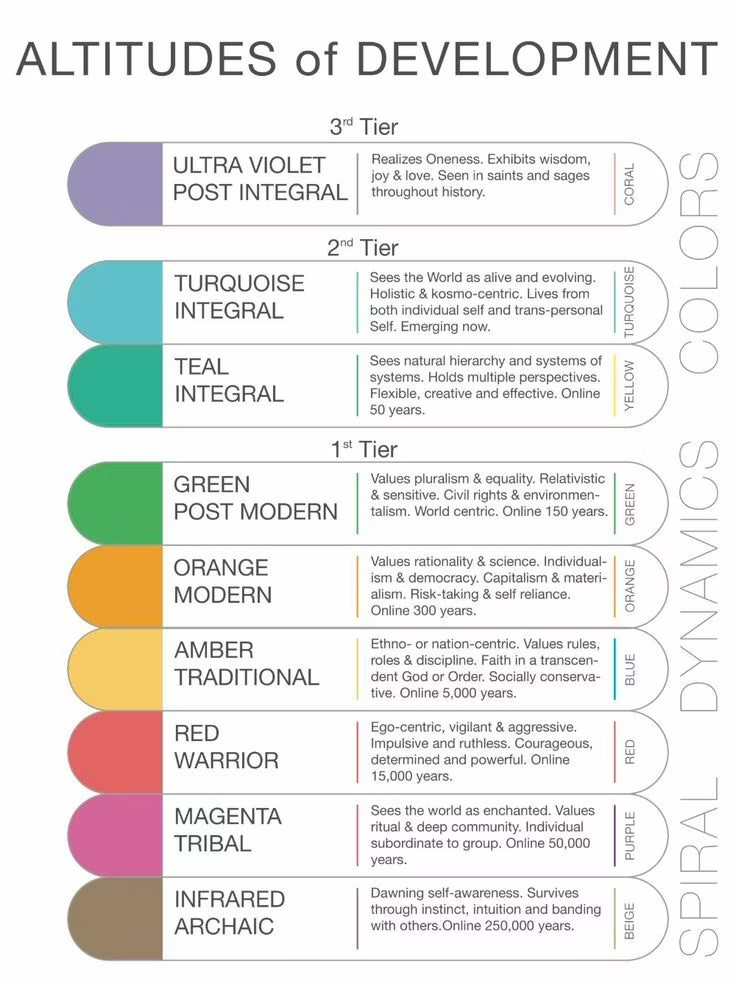
The Integral Theory by Ken Wilber: the altitudes of development, AKA the stages of development.
The Integral Theory by Ken Wilber examines the altitudes of development, also known as the stages of development. These altitudes represent different levels of consciousness and understanding that individuals can progress through. Each altitude builds upon the previous one, encompassing and transcending it to create a more complex and integrated worldview.

The AQAL upper-right perspective (it) provides a valuable lens through which we can examine and understand the world around us. It focuses on the individual and their subjective experience, paying attention to their thoughts, emotions, and personal growth.
Through this perspective, we gain insight into the unique ways individuals live their lives. We see how they make decisions and interact with others. It helps us appreciate the complexity of human experiences. We are reminded that there is no one-size-fits-all approach to understanding or addressing the challenges we face.
By considering the AQAL upper-right perspective (it), we can foster empathy and cultivate a deeper understanding of ourselves and others. We recognize that everyone’s perspective is valid and valuable, contributing to the rich tapestry of human existence. Embracing this perspective enhances our capacity for connection, compassion, and personal growth.

The Lower-left perspective (we) offers a unique vantage point that is often overlooked. By shifting our focus away from the center, we can gain new insights and uncover hidden truths. This alternative viewpoint challenges the status quo and encourages fresh perspectives to shape our understanding of the world.
By embracing the Lower-left perspective (we), we can break free from the limitations of traditional thinking. It prompts us to question existing power structures and explore alternative approaches. This shift in mindset opens up a world of possibilities. It allows us to challenge the dominant narratives. We can redefine what is considered normal or acceptable.
In a world that can often feel polarized, the Lower-left perspective (we) reminds us of the importance of collective action. It urges us to come together, hear one anther’s voices, and work towards a common goal. We can amplify marginalized perspectives. We should acknowledge the interconnectedness of our experiences. This approach helps create a more inclusive and equitable society for all.
The collective future of humanity lies in our ability to work together, to overcome challenges, and to strive for progress. It is a future that demands our attention and calls for collective action. With the ever-increasing interconnectedness of our world, global issues require global responses.
We must secure a bright and sustainable future. To do this, we must address pressing issues such as climate change. Inequality and social injustice are also priorities. These challenges not only affect one particular group or nation but have ripple effects that impact the entire globe. It is only through cooperation, empathy, and a shared sense of responsibility that we can navigate and overcome these obstacles.
Furthermore, the future of humanity also rests on our ability to harness the potential of technology and innovation. The rapid advancement of artificial intelligence, automation, and biotechnology presents both opportunities and risks. We must use these tools wisely. They should benefit all of humanity and be guided by ethical considerations.
In conclusion, the collective future of humanity is a shared responsibility. It requires us to transcend boundaries. We must think beyond our own interests. We need to come together to address the challenges that lie ahead. By working together and embracing innovation, we can create a future that is inclusive, sustainable, and prosperous for all.

The Lower-Right Perspective (Its) offers a unique lens through which to view the world. By focusing on the minute details and intricacies, this perspective grants a deeper understanding of our surroundings. It allows us to appreciate the beauty in the mundane and discover hidden connections that may otherwise go unnoticed.
Interplay between the inner and outer perspectives. The external.
The AQAL lower-right perspective (Its) offers a unique lens to understand complex systems and their relationships. By focusing on the individual and the external environment, this perspective emphasizes the significance of both internal and external contexts. Its holistic approach recognizes the interconnectedness of various elements, highlighting the interdependencies between different aspects of the whole.
In this perspective, the emphasis is on understanding individual experiences, behaviors, and beliefs. They shape their external surroundings and are shaped by them. It recognizes that not only do individuals influence their environment, but they are also profoundly influenced by it. This perspective acknowledges the dynamic nature of the relationship between individuals and their surroundings. It recognizes the mutual impact they have on each other.
Moreover, the AQAL lower-right perspective sheds light on the importance of social structures. It emphasizes cultural norms and societal influences in shaping individual behavior. People are shaped by these elements and their cognitions are affected.
In conclusion, the AQAL lower-right perspective offers valuable insights into the complex dynamics of individuals and their environment. By recognizing the interplay between internal and external factors, this perspective provides a nuanced understanding of human experiences. It contributes to a more holistic and comprehensive view of complex systems.
Ken Wilber
AQAL stages of development:
8. Human Development Stages
The AQAL framework, developed by Ken Wilber, provides a comprehensive model for understanding human development. It encompasses the various dimensions of an individual’s growth, including cognitive, emotional, and spiritual aspects. The AQAL framework emphasizes multiple perspectives. It integrates various developmental stages. This approach offers a rich understanding of human evolution.
One of the key insights of the AQAL model is that individuals don’t progress through stages in a linear fashion. Rather, development is seen as a complex web of interrelated stages that interact with and influence each other. This means that growth doesn’t follow a straightforward path from one stage to the next. Instead, it is a dynamic process of integration. It involves differentiation as well.
By examining these AQAL stages of development, we gain a deeper understanding of the complexities and nuances of human growth. From the egocentric red stage, the AQAL framework invites us to recognize the diversity. It also highlights the multiplicity of human experiences as we move to the ethnocentric green stage and beyond. It encourages us to embrace the richness and complexity of each individual’s developmental journey.
Worldviews Jean Gebser
The Gebser Worldviews, named after the influential Swiss philosopher Jean Gebser, categorize different stages of human consciousness development. These stages include the archaic, magic, mythical, mental, and integral worldviews. Each worldview represents a unique perspective on reality, shaping individuals’ perceptions and understanding of the world.
Understanding the Gebser Worldviews enables us to appreciate the rich diversity of human experience. These worldviews offer a framework for exploring the evolution of human consciousness. They start with the archaic worldview, where consciousness focuses on immediate survival. Later, they progress to the integral worldview. This stage embraces holistic thinking and interconnectedness.
By studying the Gebser Worldviews, we can also gain insights into the dynamic relationship between individuals and societies. Different cultures embody different worldviews, which impact their collective beliefs, values, and behaviors. Recognizing these influences can help foster cross-cultural understanding and promote global cooperation.
In conclusion, the Gebser Worldviews offer a valuable lens through which to explore the complexity of human consciousness throughout history. By understanding these worldviews, we can appreciate the many ways people perceive the world. We can also see how societies navigate their surroundings.
Gebser’s Worldviews represent a comprehensive framework for understanding the different ways in which humans perceive and interpret reality. These worldviews acknowledge the ever-evolving nature of consciousness and highlight the various stages of human development. Each stage denotes a shift in consciousness, leading to a different perception of the world and our place in it.
The first stage, the archaic worldview, refers to a primal and instinctual understanding of reality. This is followed by the magical worldview, where humans perceive the world as interconnected and imbued with mystical forces. The mythical worldview, by contrast, involves creating symbolic systems. These systems help make sense of the world and its mysteries.
Moving further, the mental-rational worldview represents a significant shift towards abstract thinking, logic, and reasoning. This stage is characterized by an emphasis on scientific inquiry and objective knowledge.
The Green Post Modern worldview explores the intersection between environmentalism and postmodern philosophy. It recognizes the social, political, and cultural dimensions of environmental issues. It emphasizes the importance of inclusivity and diversity in addressing them. This worldview challenges traditional notions of progress and development, advocating for more sustainable and equitable ways of living.
The Green Post Modern worldview emphasizes the interconnectedness of all life forms. It highlights the connections between ecosystems. It rejects the notion of human superiority and instead promotes the idea of coexistence and mutual respect with nature. This perspective also acknowledges the role of power dynamics in determining environmental outcomes. It highlights the need for marginalized communities to have a voice in environmental decision-making.
Another important element of this worldview is its rejection of simplistic dualities and categorical thinking. It recognizes the complexity and fluidity of the world, embracing uncertainty and multiple perspectives. This creates room for more nuanced discussions about environmental issues. It also encourages exploring alternative solutions beyond traditional binary approaches.
In conclusion, the Green Post Modern worldview offers a comprehensive framework for understanding and addressing environmental challenges. Its focus on inclusivity, interconnectedness, and complexity offers valuable insights. These insights help in shaping sustainable and equitable futures for both humanity and the planet.
The pluralistic worldview acknowledges the existence of diverse perspectives and beliefs within a society. It recognizes the value of different opinions and encourages open dialogue and understanding. By embracing this perspective, individuals can foster inclusivity and promote mutual respect, even when faced with conflicting ideas.
In a pluralistic society, the exchange of ideas becomes an opportunity for growth and learning. Rather than dismissing opposing viewpoints, individuals strive to find common ground and bridge the gaps between different communities. This approach encourages collaboration and innovation, as it allows for the integration of various perspectives to tackle complex issues.
However, navigating pluralism isn’t without its challenges. It requires a willingness to challenge our own biases. We must also remain open to continuously learning from others. The pluralistic worldview prompts us to critically evaluate our beliefs and engage in meaningful conversations that foster empathy and understanding. By embracing pluralism, we can strive for a more inclusive and harmonious society that values the richness of diversity.
In conclusion, this worldview supports a dynamic society. It embraces the complexity of human experiences. It also values the diverse perspectives that shape our understanding of the world. We can engage in dialogue. We can embrace differences and continuously learn from one another. This helps us work towards a more inclusive and harmonious society.
Finally, the integral worldview integrates all previous stages. It embraces the notion that reality is multifaceted. Reality cannot be fully understood from a single perspective.
https://7hh.is/the-wholeness-in-our-being/
The Integral mindset
Got it — you’re asking why the integral mind is often seen as the preferred or most advanced stage of development.
Here’s a clear explanation:
The integral stage (sometimes called integrative or second-tier consciousness in developmental psychology, like in Ken Wilber’s Integral Theory or Spiral Dynamics) represents a level of awareness where a person can see value in all previous stages of development and integrate them rather than rejecting or judging them.
Here’s why it’s considered the preferred or most mature stage:
- Inclusivity of Perspectives
- People at this stage recognize that every worldview — rational, emotional, traditional, or modern — has some truth.
- Instead of seeing others as “wrong,” they see how each perspective fits into a larger whole.
- Self-Transcendence
- The integral mind moves beyond ego-driven identity.
- It’s less about “me” and more about “we” — understanding oneself as part of an interconnected system.
- Complex Thinking
- It can hold paradoxes and contradictions without needing to resolve them immediately.
- This allows for creative problem-solving and adaptive leadership.
- Emotional and Spiritual Maturity
- There’s a deep sense of empathy, compassion, and purpose.
- The person feels aligned with something larger than themselves — whether that’s humanity, nature, or a shared mission.
- Integration of Action and Reflection
- The integral mind doesn’t just think holistically; it acts holistically.
- Decisions are guided by both rational analysis and intuitive wisdom.
The Knowledge Structure
Workshop
Multi Intelligence Development
https://7hh.is/emotional-intelligence/
https://7hh.is/somatic-intelligence/
https://7hh.is/the-will-power-line-of-development/
https://7hh.is/moral-intelligence/
https://7hh.is/spiritual-intelligence/
https://7hh.is/inter-personal-intelligence-line/
https://7hh.is/intra-personal-line/
https://7hh.is/the-cognitive-line-of-intelligence/
Presentation – Personal Transformation by Guðbjörg Eggertsdóttir
https://7hh.is/our-support-systems/
https://7hh.is/2025/11/18/the-compasses-for-government/
https://7hh.is/2025/09/20/boundaries-in-society/
https://7hh.is/2025/09/20/consideration-by-ai/
https://7hh.is/2025/09/18/respect-is-importance/
https://7hh.is/2025/11/15/daniel-s-siegel-about-interconnected/
https://7hh.is/2025/09/18/interconnected/
https://7hh.is/2025/09/18/equilibrium-in-society/
https://7hh.is/2025/09/20/lenses-in-politics/
Adaptation in organisations
https://7hhis.wordpress.com/?p=2839&preview=true
Adaptation in Society
https://7hhis.wordpress.com/?p=2842&preview=true
The Luminous Future


 7hh.is
You must be logged in to post a comment.