Here are some practical, grounded steps you can take to apply the three “liberations” — Eastern, Western, and Indigenous — in everyday life. Since nothing relevant appeared in your personal workspace, I’ll offer a general but actionable synthesis you can use right away.
1. Eastern: Cultivate Inner Clarity and Presence
These steps strengthen the self‑liberation dimension.
Daily practices
• Keep a simple meditation practice (even 5–10 minutes).
• Develop a reflective habit such as journalling at the end of the day.
• Notice automatic reactions and choose responses more consciously.
Applied mindfulness
• Take one regular activity — walking, cooking, showering — and treat it as a mindfulness practice.
• Use brief pauses during the day (e.g., before meetings or decisions).
Inner development goals
• Work on emotional regulation, self‑awareness, and shadow integration.
• Learn a contemplative skill: breathwork, tai chi, yoga, or similar.
2. Western: Actively Support Fairness, Dialogue, and Better Systems
This is the community‑liberation dimension.
In your circles and workplace
• Encourage transparent processes (clear decisions, clear roles).
• Practise “good governance” even in small group settings — meetings, planning, agreements.
• Offer constructive feedback and invite it in return.
• Build inclusive habits: actively draw quieter voices into discussions.
Civic engagement
• Stay informed about local decisions; vote with intention.
• Support organisations that advance justice, rights, or social wellbeing.
• Learn conflict‑resolution or dialogue skills such as Nonviolent Communication.
Personal ethics
• Align your behaviour with values: honesty, fairness, accountability.
• Intervene gently when you see harm, bias, or misinformation.
3. Indigenous: Reconnect with Nature and Reciprocity
This is the ecological‑relationship dimension.
Daily or weekly connection
• Spend time outdoors — not just recreationally but attentively.
• Learn the names of local plants, birds, winds, seasons.
• Practise gratitude rituals (simple, secular, or spiritual).
Reciprocity
• Reduce waste, repair more, buy less.
• Support conservation or local landcare initiatives.
• Grow something (even small herbs on a windowsill).
Way of knowing
• Practise listening deeply, both to people and to place.
• Approach the natural world as alive — not metaphorically, but relationally.
4. Integration: Where the Three Traditions Meet
This is where transformation actually happens.
Combine inner clarity + ethical action + ecological awareness
Examples:
• Before making decisions, pause (Eastern), consider fairness (Western), and consider ecological impact (Indigenous).
• When frustrated, ground yourself (Eastern), speak honestly but kindly (Western), and reconnect with something larger than the immediate moment (Indigenous).
• Structure your life around practices that support all three — e.g., mindful walking in nature, or community projects that include inner reflection.
Create “integral spaces”
• Start meetings or groups with a short mindful pause.
• Build rituals of appreciation or gratitude.
• Ensure decisions consider personal, interpersonal, and ecological consequences.
Personal yearly or quarterly plan
Make three commitments:
• One that grows you (inner practice).
• One that helps others (community contribution).
• One that heals the Earth (ecological reciprocity).
Here are some examples of “integral spaces”, drawing on your question and supported by themes found in your files that emphasise presence, connection, balance, and integration across self, community, and environment. These aren’t labelled as “integral spaces” in your documents, but the underlying practices and qualities align closely with what such spaces aim to cultivate.
1. Spaces that Cultivate Presence and Deep Connection
Your files repeatedly highlight presence, stillness, deep listening, and authentic connection as foundations for meaningful interaction. These are core qualities of an integral space.
For example, 3. Connected grammarly emphasises presence, deep listening, eye contact, and shared silence as ways to create genuine connection1, and 3 Connected with Grammarly final reinforces stillness and attention as the basis for trust and engagement2.
Examples of such spaces:
• A meeting that begins with a minute of silence or mindful grounding
• A team environment where deep listening is practised and interruptions are minimised
• Coaching or mentoring sessions designed around spaciousness, reflection, and presence
• Retreat-style workshops where people slow down, connect, and listen
2. Spaces Designed for Human Growth and Inner Development
The Tides documents describe leadership development as an integrated process involving self‑acceptance, adaptation, balance, and purpose34. These themes map directly onto the “Eastern” liberative tradition (inner growth and clarity).
Examples of such spaces:
• Leadership programmes that include mindfulness, emotional awareness, and purpose‑finding
• Dedicated personal reflection rooms or quiet rooms in organisations
• Workshops blending somatic practices, self‑inquiry, and learning
• Group processes where people explore values, identity, and purpose together
3. Spaces that Foster Communal Care, Consideration, and Fairness
Your document 4 Consideration final 17‑2 highlights the balance between caring for oneself and caring for others, and the importance of mindful empathy and trust‑building in groups5.
This aligns with the Western liberative tradition: equitable systems, empathy, dialogue, and shared responsibility.
Examples of such spaces:
• Circles of dialogue where all voices are invited and respected
• Democratic decision‑making spaces with clear processes and shared norms
• Team agreements or charters that emphasise fairness, boundaries, and care
• Community forums designed to surface collective wisdom rather than conflict
4. Spaces Connected to Nature and Ecological Awareness
Your files discuss nature metaphors and connection to environment as part of leadership and human development—especially in the Tides content, which uses nature as a teacher and grounding influence34. This aligns with Indigenous traditions of ecological reciprocity.
Examples of such spaces:
• Outdoor meeting spaces or walking‑meetings
• Nature‑based retreats or reflection days
• Gardens, green areas, or “sacred outdoor spots” integrated into organisational life
• Workspaces with ecological rituals, such as land acknowledgements or tending to shared plants
5. Fully Integral Spaces (Bringing All Three Together)
A truly integral space integrates inner practice, relational ethics, and ecological connection. Here are examples that combine all three traditions:
• A leadership retreat with meditation (inner), group dialogue (community), and time in nature (ecological)
• A workplace that uses mindful check‑ins, democratic processes, and environmental stewardship practices
• A learning environment that values personal reflection, collective inquiry, and land‑based wisdom
• Community hubs where people gather for meditation, storytelling, ecological restoration, and dialogue.
Here are practical, grounded steps to create an integral space, directly drawing on the themes of presence, connection, inclusivity, balance, self‑awareness, and multi‑perspectival awareness that appear across your personal documents — such as The Four Doors, Connected, AQAL, and Tides.
Each step below is supported by relevant files in your workspace.
1. Begin with Inner Grounding (Eastern – Self‑liberation)
Your files stress that presence and inner clarity are the foundation for any connected or transformative space.
Practical steps
• Start gatherings with a minute of silence, breath awareness, or grounding.
– Presence and stillness are described as essential for connection1.
• Encourage participants to set a personal intention such as “May I be fully present” before entering the conversation.
– This is recommended in Connected grammarly1.
• Foster emotional safety and self-awareness — this is the UL (inner experience) quadrant in The Four Doors2.
2. Create Conditions for Meaningful Connection (Western – Relational + Communal)
Your documents show that meaningful connection grows from deep listening, trust, openness, and shared meaning.
Practical steps
• Use deep listening protocols — e.g., let each person speak without interruption and include pauses before responses.
– Deep listening is central to trust and connection in Connected with Grammarly final3.
• Encourage soft, steady eye contact and slow pacing.
– Eye contact builds trust and mutual recognition in your documents1.
• Build shared meaning through storytelling or check‑ins that surface group experience.
– Shared meaning is a core LL (collective interior) dimension in The Four Doors2.
• Establish group agreements that emphasise respect, kindness, and curiosity.
3. Bring in Multi‑Perspective Awareness (Integral framing / AQAL)
Your AQAL file outlines the value of including multiple perspectives (inner/outer, individual/collective) in any holistic space.
Practical steps
• Structure conversations so they address all four quadrants — inner feelings, interpersonal dynamics, practical behaviours, and wider systems.
– AQAL emphasises using all quadrants for a full view of a situation4.
• Invite diverse viewpoints and explicitly welcome differing experiences.
– Your AQAL document stresses the value of diversity in perspectives for better solutions4.
• Use reflection prompts like:
– “What am I experiencing internally?”
– “How are we relating as a group?”
– “What actions or behaviours do we see?”
– “What systems or contexts influence this?”
4. Integrate Nature, Embodiment, and Balance (Indigenous + Tides themes)
Your Tides book emphasises nature metaphors, body‑mind integration, balance, and connection with the environment.
Practical steps
• Hold sessions outdoors when possible or bring natural elements into the room (plants, natural materials, airflow, sunlight).
– Tides uses nature as a guide for grounded leadership and connection5.
• Include grounding activities such as gentle movement, slow breathing, or mindful walking.
• Build rhythms into the space — cycles of reflection, dialogue, silence, and action.
– Tides emphasises balance and integrated pacing for sustainable leadership5.
5. Establish a Developmental Arc (Transformation over time)
Your Tides material focuses on growth through stages — self‑acceptance → adaptation → connection → consideration → balance → purpose.
Practical steps
• Structure your space so participants move through phases rather than stay in one mode.
– This developmental sequence is central to Tidesproof-12-3-265.
• For example:
– Begin with inner grounding (self‑acceptance).
– Move into sharing and relating (connection).
– Introduce mutual responsibility (consideration).
– Explore whole-systems context (balance).
– End with purpose‑setting or commitments.
6. Hold a Field of Compassion, Empathy, and Mindfulness
Your Spiritual Master Keys file emphasises empathy, compassion, calmness, and perspective‑taking.
Practical steps
• Introduce empathy exercises such as “walk in their shoes” perspectives.
– The file explicitly encourages perspective‑taking and mindfulness for compassion6.
• Encourage pauses in conflict moments to restore calmness and reconnect with intention.
• Maintain a tone of appreciation, gratitude, and authentic kindness.
Summary: Your Integral Space Design in 6 Steps
Ground in presence – silence, intention, awareness.
Establish deep relational connection – listening, trust, open dialogue.
Include all perspectives – AQAL quadrants, diverse voices.
Integrate nature and embodiment – pacing, environment, balance.
Follow a developmental arc – from self-awareness to purpose.
Hold empathy and compassion – calmness, perspective-taking.
Below is a complete, ready‑to‑use facilitation script for running an integral session. Since no material in your personal workspace matches “facilitation script integral session”, I’ve designed this based on the themes in your earlier questions: presence, connection, multiple perspectives, and ecological awareness.
The script is written so you can read it aloud or adapt it for workshops, team meetings, retreats, or reflective sessions. It follows the three liberations — inner (Eastern), relational (Western), ecological (Indigenous) — and integrates them.
Facilitation Script for an Integral Session
Total duration: 45–75 minutes
Group size: 2–20
Purpose: Create a space that integrates inner awareness, relational connection, systemic clarity, and ecological presence.
1. Opening the Space (5 minutes)
Facilitator
“Welcome, everyone.
Today we’re creating an integral space — a space where we bring our full selves, our shared humanity, and our connection with the wider world into the same room.
Before we begin, let’s take a moment to arrive.”
Pause for 30 seconds.
“Feel your feet on the ground, your breath in your body, and the presence of others around you.
Notice what you bring into this space today — thoughts, emotions, expectations — and simply let them be.”
2. Setting Intention (3–5 minutes)
Facilitator
“I’d like to invite you to set an intention for our time together. It can be a word, a quality, or a way of being — such as curiosity, openness, calm, courage, or connection.”
Pause.
“If you’d like, share your intention aloud in a single sentence.”
(Go around the circle quickly; no commentary.)
3. Deep Listening Round (10–15 minutes)
Purpose: Establish relational presence and trust.
Facilitator
“We’ll begin with a round of deep listening. Each person will have up to two minutes to answer this question:
‘What feels most alive or important in your world right now?’
When someone speaks, we simply listen — no interruptions, no questions.
When they finish, we hold a brief pause before the next person begins.”
Begin the round.
After everyone has spoken, offer:
“Thank you. Take a breath and acknowledge the richness of what’s been shared.”
4. Multidimensional Reflection (AQAL-inspired) (10–15 minutes)
Facilitator
“We’ll now look at the theme on the table today — whether it’s a challenge, a project, or a question — through four perspectives.”
Introduce each briefly:
• Inner self: ‘What’s happening in me?’
• Relationships: ‘What’s happening between us?’
• Behaviour/action: ‘What’s actually being done?’
• Systems/context: ‘What structures or forces shape this?’
Prompt
“Reflect silently for a minute: What do you notice in each of these four areas?”
After one minute
“I invite you to share one insight that came up for you. Just one sentence each.”
(Take one sentence per person; keep it tight.)
5. Nature / Embodiment Moment (5 minutes)
Purpose: Reconnect with grounding, clarity, and embodied intelligence.
Facilitator
“Let’s come back into the body and into the wider field we’re part of.
If we’re indoors, feel the air, the weight of your body, and imagine the land beneath the building.
If we’re outdoors, open your senses to sound, light, movement, and the more‑than‑human world around you.”
Guide a brief embodied exercise:
“Take three slow breaths.
Let your shoulders soften.
Notice a sense of being supported — by the ground, the air, the space itself.”
(Optional: Invite a brief walk or stretch.)
6. Dialogue + Integration (10–15 minutes)
Facilitator
“From everything we’ve touched — our inner experience, our relationships, our actions, and the wider context — what is emerging now as important?”
Invite open dialogue with these principles:
• Speak from experience.
• Listen for meaning, not reply.
• Leave space between contributions.
• Stay curious about differences.
Support the group to explore emerging themes without forcing resolution.
7. Purpose / Commitment Round (5 minutes)
Facilitator
“To close, I’ll invite a short round where each person names one thing they are taking from this session — a commitment, a realisation, or a next step.”
(One sentence per person.)
“Thank you for showing up with presence and openness.”
8. Closing the Space (1–2 minutes)
Facilitator
“Take one final breath together.
Feel gratitude for the collective intelligence we’ve created.
This space is now closed. Thank you.”
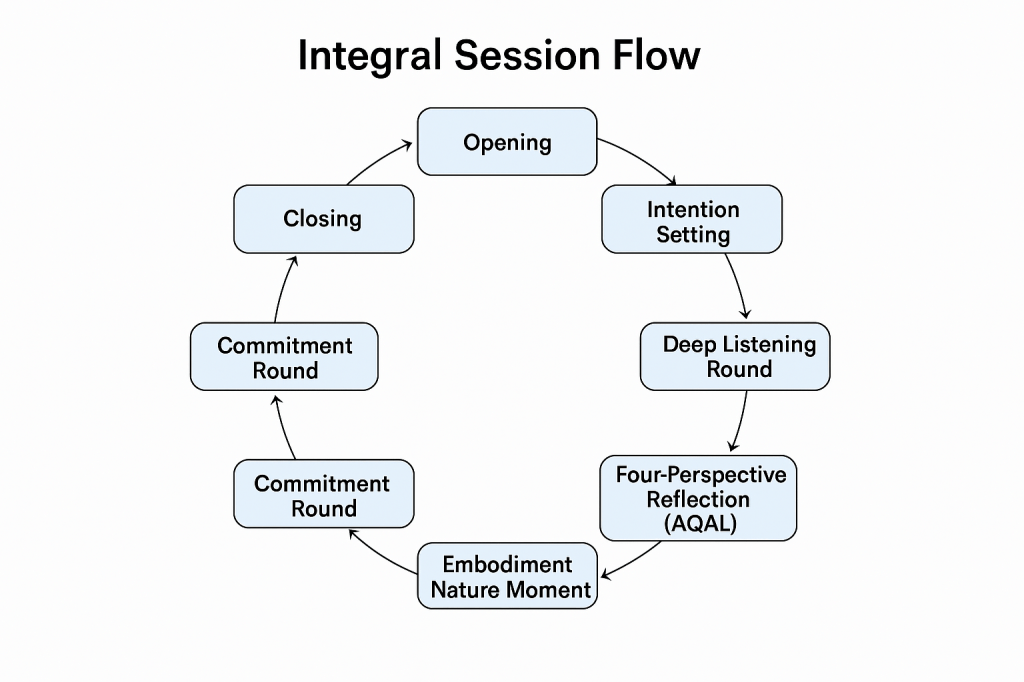
Here is a clean, printed one‑page facilitation script — concise, practical, and ready to use as a handout. It contains no surplus text and fits comfortably on a single A4 page.
You can copy/paste directly into a document for printing.
Integral Session – One‑Page Facilitation Script
Duration: 45–60 minutes
Purpose: Create a space that integrates inner awareness, relational connection, systemic clarity, and ecological presence.
1. Opening (1 minute)
“Welcome. Let’s take a moment to arrive.”
• Pause in silence (20–30 seconds).
• “Notice your breath, body, and the presence of others.”
2. Intention Setting (3 minutes)
“Choose an intention — a word or quality you want to bring (e.g., calm, curiosity, courage).”
• Quick round: each person shares one sentence.
3. Deep Listening Round (10 minutes)
Prompt: “What feels most alive or important for you right now?”
• 1–2 minutes per person.
• No interruptions, no responses.
• Hold a short pause between speakers.
Close with: “Thank you for your presence.”
4. Four‑Perspective Reflection (AQAL) (10 minutes)
Prompt:
• Inner self: What am I experiencing?
• Relationships: What’s happening between us?
• Behaviour: What actions or patterns do I notice?
• Systems: What wider forces or contexts are shaping things?
Silent reflection: 1 minute.
Sharing round: one sentence per person.
5. Embodiment / Nature Moment (3–5 minutes)
“Feel your feet on the ground. Soften your shoulders. Notice your breath.”
If outdoors: “Open your senses to wind, sound, and movement.”
If indoors: “Feel the support beneath you; sense the wider world beyond the room.”
(Option: brief standing stretch or slow breath cycle.)
6. Dialogue + Integration (10–15 minutes)
Prompt: “Given what we’ve heard and sensed, what is emerging as important now?”
Guidelines:
• Speak from experience.
• Listen for meaning, not reply.
• Leave space between contributions.
• Stay curious.
7. Commitment Round (5 minutes)
Prompt: “What is one thing you’re taking from today — insight, intention, or next step?”
• One sentence per person.
8. Closing (1 minute)
“Take a final breath together.
Thank you for your openness and presence. This space is now closed.”
 7 H H
7 H H 
You must be logged in to post a comment.