To better understand what they experience, map their experience also how it flows. Make experiments and use diverse approaches. Use design thinking and the seven hats.
Mapping Human Experience Through Design Thinking and the Seven Hats
1. Understanding the Experience
Begin by immersing in the perspective of those whose experience is being explored. Observe, listen, and empathize to uncover emotional, cognitive, and behavioral patterns. Identify what they value, what frustrates them, and what motivates their actions. Use interviews, shadowing, and journaling to capture authentic insights.
2. Mapping the Flow
Visualize the journey as a flow of experiences rather than isolated events.
- Touchpoints: Identify where interactions occur—physical, digital, emotional, or relational.
- Emotions: Track emotional highs and lows to reveal moments of delight or friction.
- Transitions: Note how people move from one stage to another and what triggers those shifts.
- Context: Include environmental, social, and internal factors that shape perception.
Tools such as journey maps, empathy maps, and service blueprints help make invisible experiences visible.
3. Experimentation and Diverse Approaches
Adopt an experimental mindset. Prototype ideas quickly and test them in real contexts. Use multiple methods—storytelling, role-playing, co-creation workshops, and sensory mapping—to explore different dimensions of experience. Encourage diversity in participants and perspectives to uncover hidden assumptions and broaden understanding.
4. Applying Design Thinking
Use the five stages of design thinking as a flexible framework:
- Empathize: Deeply understand the people and their context.
- Define: Synthesize insights into clear problem statements.
- Ideate: Generate a wide range of creative possibilities.
- Prototype: Build tangible representations of ideas.
- Test: Gather feedback and refine based on real-world reactions.
Iterate continuously, allowing insights from testing to reshape understanding and direction.
5. Integrating the Seven Hats
Use Edward de Bono’s Seven Thinking Hats to explore the experience from multiple cognitive angles:
- White Hat (Facts): Gather data, evidence, and objective information.
- Red Hat (Feelings): Surface emotions, intuitions, and gut reactions.
- Black Hat (Caution): Identify risks, weaknesses, and potential problems.
- Yellow Hat (Optimism): Highlight benefits, opportunities, and positive outcomes.
- Green Hat (Creativity): Generate new ideas and unconventional solutions.
- Blue Hat (Process): Manage the thinking process and maintain focus.
- Purple Hat (Wisdom/Context): Reflect on ethical, cultural, and systemic implications.
Rotate through these perspectives during workshops or reflection sessions to ensure a balanced and holistic understanding.
6. Synthesizing Insights
Combine findings from mapping, experimentation, and the seven hats to reveal patterns and opportunities. Translate insights into actionable principles or design criteria that guide future decisions. Document the flow of experience as a living system—dynamic, relational, and evolving.
7. Continuous Learning
Treat the process as ongoing. Each iteration deepens understanding and refines empathy. Encourage feedback loops, reflection, and adaptation to sustain relevance and authenticity in the evolving human experience.
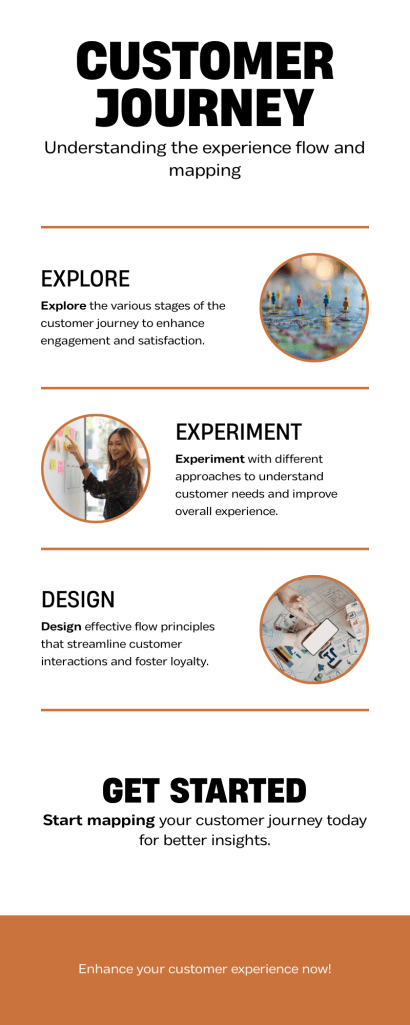
Experience flows
The Flow of Customer Experience and Its Influence on Future Orientation
1. The Ripple Effect of Experience
Customer experience extends beyond the individual encounter. Each interaction creates emotional and cognitive ripples that influence others—employees, peers, communities, and even the organization’s identity. A positive experience fosters trust, advocacy, and shared meaning, while a negative one can generate resistance, disengagement, or reputational erosion. Experience thus becomes a living network of influence rather than a closed transaction.
2. Flow Across Touchpoints and Relationships
Customer experience flows through interconnected layers:
- Individual Level: Emotions and perceptions shape satisfaction, loyalty, and memory.
- Relational Level: Customers share stories, recommendations, and feedback, influencing others’ expectations and decisions.
- Organizational Level: Insights from experiences inform internal learning, service design, and cultural alignment.
- Societal Level: Collective experiences shape brand reputation, social narratives, and trust in institutions.
Mapping this flow reveals how one person’s journey becomes part of a larger ecosystem of meaning and behavior.
3. Experience as a Feedback System
Every experience generates feedback loops that guide adaptation and growth.
- Direct Feedback: Surveys, reviews, and conversations provide explicit signals.
- Indirect Feedback: Behavioral patterns, emotional tone, and social sharing reveal implicit responses.
Organizations that listen and respond to both forms of feedback evolve more effectively, aligning their future orientation with real human needs.
4. Influence on Future Orientation
Customer experience shapes how an organization envisions and prepares for the future:
- Anticipation: Understanding emerging needs and emotions helps forecast trends and design proactive solutions.
- Innovation: Insights from lived experiences inspire new products, services, and ways of relating.
- Resilience: Learning from challenges strengthens adaptability and trust.
- Purpose Alignment: Deep empathy for customers reinforces ethical and sustainable decision-making.
Future orientation becomes not just strategic but relational—rooted in continuous dialogue with those served.
5. Flow Model of Experience and Future Orientation
- Experience Creation: Interaction occurs between customer and organization.
- Emotional Resonance: Feelings and meanings are formed.
- Social Sharing: Experiences are communicated to others, shaping collective perception.
- Organizational Reflection: Insights are gathered and interpreted.
- Strategic Adaptation: Learning informs future design, innovation, and culture.
- Renewed Experience: Improved offerings create new experiences, continuing the cycle.
6. Designing for Flow and Future
To sustain a healthy flow of experience:
- Encourage open channels for feedback and storytelling.
- Integrate customer insights into strategic planning.
- Foster empathy and cross-functional collaboration.
- Use design thinking to prototype future scenarios grounded in real experiences.
- Reflect regularly on how each decision affects both current and future relationships.
7. The Living System Perspective
Customer experience is not static but dynamic—a living system of interactions that continuously shapes and is shaped by others. When organizations honor this flow, they cultivate a future orientation grounded in empathy, learning, and shared growth. The result is a resilient ecosystem where every experience contributes to collective evolution.
by Bjorg Eggerts bjorg@7hh.is


You must be logged in to post a comment.