The question “How can we have more peace in the world” is enormous, ancient, and still completely alive. And yet the answers often begin in surprisingly small, human-scale places.
Let me offer a structured, grounded way to look at it—something that honors both your systemic mind and your love of metaphor-rich, participatory thinking.
🌍 Three Layers of Peace: Inner, Relational, Collective
Peace isn’t one thing; it’s a stack of interdependent layers. When one shifts, the others move.
- Inner Peace — the personal nervous system level
This is the quiet revolution.
Peace grows when individuals can regulate, reflect, and choose rather than react.
Some leverage points:
- Slowing down enough to notice what’s happening inside
- Practices that build coherence (breathwork, meditation, ritual, movement)
- Healthy boundaries that reduce resentment and burnout
- Meaning-making that helps people feel anchored rather than threatened
Inner peace doesn’t make someone passive; it makes them less hijackable.
- Relational Peace — the interpersonal and community level
This is where your work shines: creating spaces where people can meet each other with dignity.
Relational peace grows through:
- Clear, kind communication
- Repair rituals when harm happens
- Shared agreements that reduce ambiguity
- Celebration and play (yes, play is a peace technology)
- Structures that help people feel seen and valued
When people feel safe with each other, they stop needing enemies.
- Collective Peace — the systemic level
This is the level of institutions, policies, and cultures.
Collective peace grows when societies:
- Reduce inequality
- Build fair and transparent systems
- Teach emotional literacy and conflict skills
- Create inclusive narratives of belonging
- Support cross-cultural and interfaith dialogue
- Invest in education, not polarization
Systems change when enough people inside them are capable of peace.
🌱 A Metaphor You Might Appreciate
Imagine peace as a mycelial network.
- Inner peace = the health of each node
- Relational peace = the threads connecting nodes
- Collective peace = the forest ecosystem that emerges
You don’t “install” peace.
You cultivate it.
🔧 And here’s the provocative part
We often talk about peace as if it’s the absence of conflict.
But real peace is the capacity to transform conflict without violence.
It’s a skill, not a mood.
A practice, not a utopia.
A collective muscle, not a miracle.
✨ A question to deepen the conversation
If you imagine the world as a workshop you’re facilitating,
what is the smallest, most leverage-rich intervention you’d introduce to shift the group toward peace?
I’d love to explore that with you.
Cultivating peace begins both within and between us — it’s a practice of awareness, compassion, and intentional action.
1. Inner peace
Mindfulness and presence:
Regularly pausing to breathe, notice sensations, and observe thoughts without judgment helps calm the nervous system.
Compassion practice:
Extending kindness to yourself softens inner tension and makes it easier to respond gently to others.
Alignment of values and actions:
Living in harmony with what truly matters to you reduces inner conflict and builds integrity.
2. Interpersonal peace
Deep listening:
Hearing others without rushing to respond creates understanding and dissolves defensiveness. –
Nonviolent communication:
Expressing needs and feelings clearly, without blame, fosters connection instead of conflict. –
Forgiveness:
Letting go of resentment frees energy for healing and cooperation.
3. Collective peace
Community care:
Supporting others’ wellbeing — through empathy, fairness, and shared responsibility — strengthens social harmony.
Systems thinking:
Recognizing how our choices ripple through larger systems encourages more compassionate, sustainable decisions.
Peaceful leadership:
Modeling calm, clarity, and respect inspires others to do the same. Peace grows through consistent, small acts — each breath, word, and choice can become a seed of harmony.
Letting all people cultivate peace means creating the conditions where peace is possible — in hearts, communities, and systems. It’s less about forcing peace and more about enabling it to emerge naturally.
1. Education and awareness
Teach emotional intelligence, mindfulness, and conflict resolution from an early age. – Encourage reflection and dialogue about empathy, justice, and interdependence. – Share stories and practices that show peace as strength, not passivity.
2. Access and equity
Ensure everyone has access to safety, food, healthcare, and education — peace cannot grow in chronic insecurity. – Address systemic inequalities that breed resentment and fear. – Support policies that protect human dignity and the planet.
3. Culture and community
Create spaces — physical and digital — where people can connect across differences. – Celebrate diversity through art, rituals, and shared experiences that remind us of our common humanity. – Encourage leaders, teachers, and influencers to model compassion and humility.
4. Personal responsibility and collective action
Each person can practice peace in daily interactions — listening, pausing, choosing kindness. – Communities can organize around shared values of care and cooperation. – Movements can advocate for justice without hatred, holding both firmness and compassion.
When individuals awaken to their own capacity for peace and societies nurture that awakening, peace becomes not an ideal but a shared way of being.
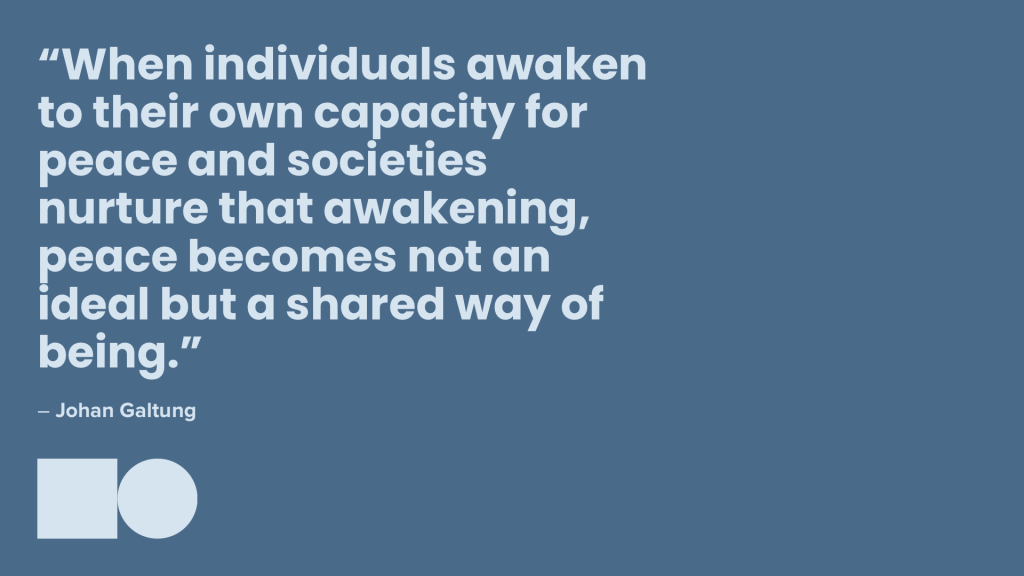
Here’s a clear, grounded snapshot of Johan Galtung, drawing on the freshest available information.
🌿 Who He Was
Johan Vincent Galtung (1930–2024) was a Norwegian sociologist and the principal founder of peace and conflict studies. He shaped the field more than any other single figure, both conceptually and institutionally. Wikipedia
📚 Key Contributions
🕊️ Founder of Peace Studies
- Established the Peace Research Institute Oslo (PRIO) in 1959 — the first institute of its kind. Wikipedia
- Founded the Journal of Peace Research in 1964, still one of the field’s leading journals. Wikipedia
- Held the world’s first professorship in peace and conflict studies (University of Oslo, 1969). Wikipedia
🔍 Intellectual Frameworks
Galtung developed a set of conceptual tools that became foundational in peace research, including:
- Structural violence — harm embedded in social systems.
- Positive vs. negative peace — peace as more than the absence of war.
- Conflict “diagnosis–prognosis–therapy” — borrowing from medicine to understand societal pathologies. Galtung-Inst…
- Reconciliation and conflict transformation models used worldwide.
🌏 Global Influence
- Published 150+ books and 1,500+ articles, translated into 30+ languages. Galtung-Inst…
- Taught at universities across the world, including Hawaiʻi and Malaysia. Wikipedia
- Received the Right Livelihood Award (1987). Wikipedia
🧭 Life Story Highlights
- Born in Oslo; lived through the Nazi occupation as a child — a formative experience. Wikipedia
- Refused military service and spent time in prison rather than compromise on peace principles. Wikipedia
- Deeply influenced by Gandhi, co-authoring Gandhi’s Political Ethics early in his career. Galtung-Inst…
⚡ Controversies & Complexity
Galtung was widely admired and widely debated.
- His prolific output and bold geopolitical predictions drew both praise and criticism.
- Scholars note he was “the most influential but also most controversial” early peace researcher. Global Campa…
🕯️ Passing
Galtung died on 17 February 2024, at age 93. Wikipedia
Image inspiration from Galtung
❄ YFIRBORÐIÐ / SURFACE ❄ DIRECT VIOLENCE (Atburðir sem sjást) -------------------------------------------- 🌊 STRÚKTÚR / STRUCTURE 🌊 STRUCTURAL VIOLENCE (Kerfi sem skapa ójafnvægi / Systemic patterns) -------------------------------------------- 🜁 MENNING / CULTURE 🜁 CULTURAL VIOLENCE (Sögur sem móta réttlætingu / Stories that justify)
Cultivating Peace: A Living Inquiry by Guðbjörg Eggertsdóttir
 7 H H
7 H H 
You must be logged in to post a comment.