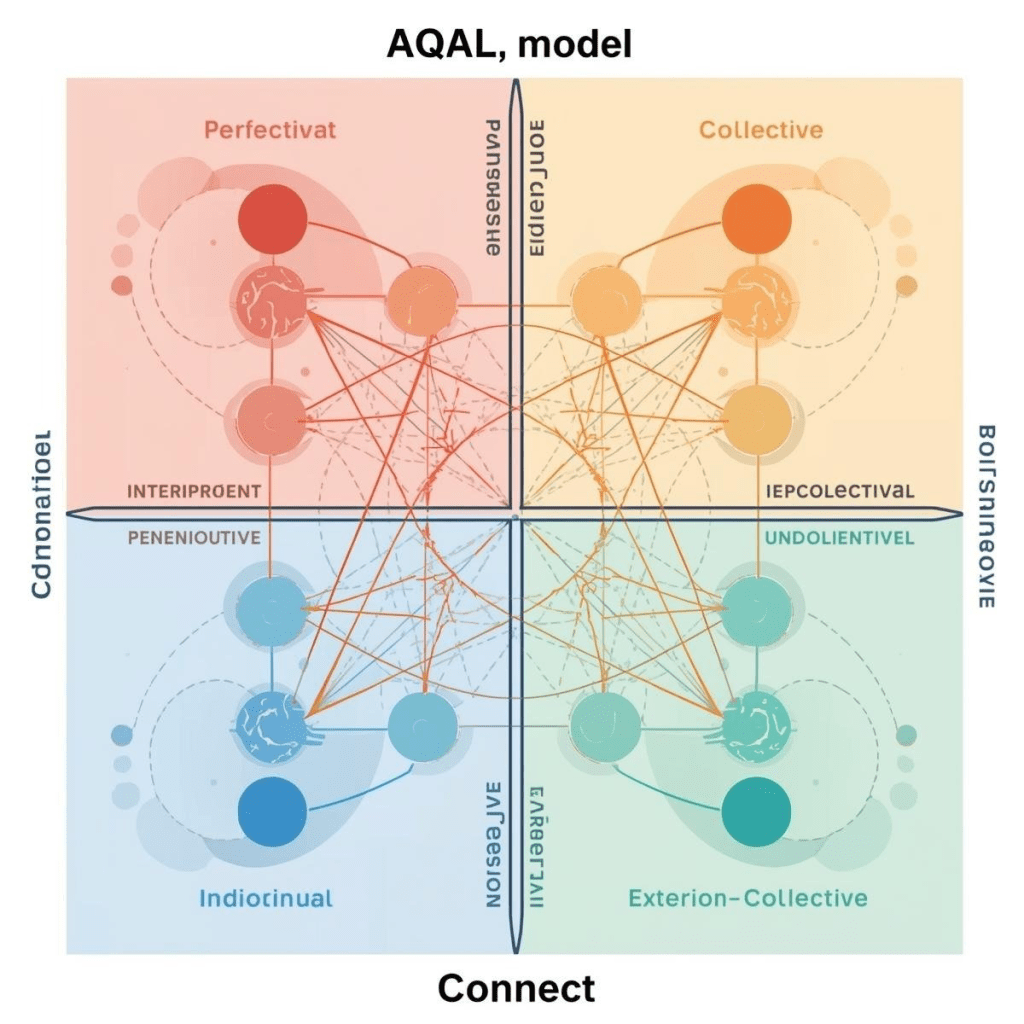
Understanding and teaching *interconnectedness* requires guiding people beyond intellectual comprehension into direct experience and embodied awareness. It’s about shifting perception—from seeing the world as a collection of separate entities to sensing it as a living web of relationships.
1. Begin with Awareness of Self as Part of the Whole
Before people can perceive external systems, they must sense their own participation in them.
Mindfulness practice:
Invite participants to notice their breath as an exchange with the environment—oxygen entering, carbon dioxide leaving. This simple act reveals interdependence with plants and the atmosphere.
Body-based awareness:
Through Qigong or gentle movement, people can feel energy flow within and beyond the body, dissolving the illusion of separation. This embodied awareness becomes the foundation for understanding interconnectedness not as a concept, but as a lived truth.
2. Reveal Patterns Through Systems Thinking
Once awareness is grounded, introduce frameworks that make invisible connections visible.
Causal loop diagrams:
Map how actions create feedback—how a company’s culture affects employee wellbeing, which in turn influences productivity and innovation.
Leverage points:
Discuss how small shifts in one part of a system can create large changes elsewhere, emphasizing responsibility and agency.
Nested systems:
Show how individuals exist within families, organizations, societies, and ecosystems—each influencing and being influenced by the others. This helps participants see that no decision or event stands alone.
3. Use Nature as a Living Teacher
Nature embodies interconnectedness effortlessly.
Observation walks:
Encourage participants to notice relationships—how fungi connect trees through mycelial networks, how pollinators sustain food systems.
Ecological metaphors:
Compare human systems to natural ones—diversity strengthens resilience, balance sustains growth, and waste in one process becomes nourishment in another. By observing nature, people internalize the wisdom of interdependence.
4. Cultivate Emotional and Ethical Connection
Understanding interconnectedness also awakens compassion.
Heart-based reflection:
Invite participants to contemplate how their wellbeing is tied to others’—how kindness, fairness, and care ripple outward.
Compassion practices:
Loving-kindness meditation or gratitude journaling can expand awareness from self to community to planet. This emotional dimension transforms understanding into responsibility.
5. Integrate Through Collective Practice
Interconnectedness becomes real when experienced in relationship.
Collaborative learning:
Design group projects where success depends on cooperation, listening, and shared purpose.
Dialogue circles:
Use deep listening and inquiry to explore how each person’s perspective contributes to a larger understanding.
Community rituals:
Shared movement, song, or silence can create a felt sense of unity beyond words. Through these experiences, people *feel* the web they are part of.
6. Encourage Continuous Reflection
Interconnectedness is not a single insight but an ongoing practice. Encourage journaling, art, or storytelling to help participants notice how their awareness evolves—how they see connections in daily life, relationships, and work.
Teaching interconnectedness, at its deepest level, is about awakening perception. It’s not only about systems or ecology—it’s about remembering that life itself is relationship, and that every thought, action, and breath participates in the whole.
Leading in Interconnected Systems by Guðbjörg Eggertsdóttir
 7 H H
7 H H 
You must be logged in to post a comment.