Stakeholders are individuals or groups who have an interest in, or are affected by, a company’s actions, decisions, and performance. They can be internal or external, and their influence and expectations often shape how a company operates and makes strategic choices.
Here’s a breakdown of the main types of stakeholders and their roles:
1. Internal Stakeholders
These are people directly involved in the company’s operations.
- Employees: They contribute their skills and time, and are affected by wages, working conditions, and job security.
- Managers and Executives: They make decisions that guide the company’s direction and are accountable for performance.
- Owners or Shareholders: They invest capital and expect returns in the form of profits or dividends.
2. External Stakeholders
These are individuals or groups outside the company who are influenced by its activities.
- Customers: They expect quality products or services and fair pricing.
- Suppliers: They rely on the company for business and timely payments.
- Investors and Creditors: They provide financial resources and expect stability and repayment.
- Communities: They are affected by the company’s social and environmental impact.
- Government and Regulators: They ensure the company complies with laws, pays taxes, and operates ethically.
3. Broader Stakeholders
These include groups with indirect but significant influence.
- Media: Shapes public perception of the company.
- Advocacy Groups and NGOs: Monitor ethical, environmental, or social practices.
- Future Generations: Increasingly considered in sustainability and long-term strategy discussions.
Stakeholder Management
Successful companies identify their stakeholders, understand their interests, and balance competing needs. This often involves:
- Mapping stakeholders by influence and interest.
- Engaging through communication and collaboration.
- Aligning business goals with stakeholder expectations to build trust and long-term value.
Stakeholders are central to systems thinking in business — each one forms part of the interconnected web that determines a company’s sustainability and success.
Key
Which one is the most importance?
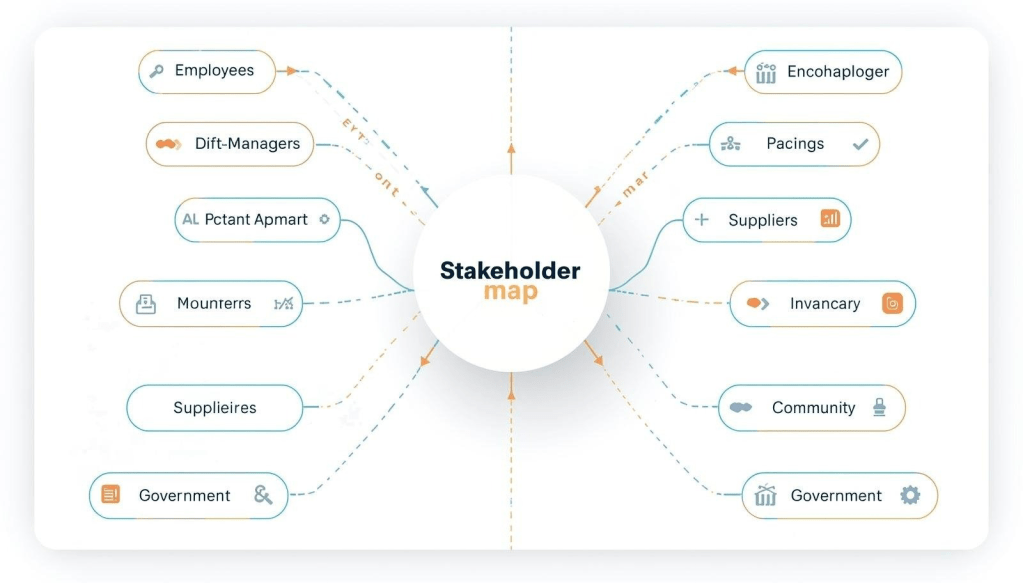
The images you’ve shared show different versions of stakeholder maps — visual diagrams that place the business at the center and connect it to all the groups that affect or are affected by it. When it comes to “which stakeholders are most important”, it depends on the company’s goals, industry, and stage of development.
However, generally speaking: —
1. Customers** They are often the most critical external stakeholders because their satisfaction drives revenue and reputation. Without customers, the business cannot survive.
2. Employees** They are essential internal stakeholders — their motivation, skills, and wellbeing directly influence productivity, innovation, and service quality.
3. Owners or Shareholders** They provide the capital and expect returns, making them key decision influencers in strategic direction.
4. Managers and Executives** They translate strategy into action and ensure the company operates effectively.
5. Suppliers and Partners** They maintain the supply chain and quality of inputs; strong relationships here ensure stability and reliability.
6. Government and Regulators** They enforce laws, taxes, and compliance standards — ignoring them can lead to serious legal and financial consequences.
7. Community and Environment** Increasingly important in modern business, as sustainability and social responsibility affect brand trust and long-term viability.
In short: **customers, employees, and owners** are typically the top three in direct importance, but **all stakeholders matter** because they form an interconnected system — neglecting one group can eventually harm the others.
Are the competitors also stakeholders in the company?
How to identify them?
Here’s a clear and practical guide on how to identify stakeholders for a company, based on general business practice.
How to identify stakeholders for a company
Identifying company‑level stakeholders is broader than identifying stakeholders for a single project. It involves looking at all the people and groups who influence, or are influenced by, the organisation’s activities.
1. Start with the company’s core activities
Ask:
• What does the company do?
• Who is affected by its operations, products, or services?
• Who provides resources the company depends on?
This helps highlight groups connected to the business.
2. Categorise stakeholders into internal and external groups
Internal stakeholders typically include:
• Employees
• Board members
• Owners or shareholders
• Managers and executives
• Internal departments (HR, finance, operations, etc.)
External stakeholders typically include:
• Customers and clients
• Suppliers and business partners
• Investors, lenders, and banks
• Regulators and government bodies
• Local communities
• Trade unions
• Industry associations
• Media
• Competitors (indirectly, as they shape the market context)
3. Use organisational documents to identify real stakeholders
Look for:
• Annual reports
• Strategy documents
• Corporate governance information
• Contracts and partnership agreements
• Marketing and customer data
• Compliance and risk registers
These reveal who interacts with the company at operational, financial, or regulatory levels.
4. Consult internal teams
Different departments often see different stakeholder groups. For example:
• Finance sees investors, auditors, and lenders
• HR sees employees, unions, training bodies
• Operations see suppliers and partners
• Legal sees regulators and compliance bodies
• Marketing sees customer segments and media
Talking to them gives a fuller picture.
5. Map stakeholder influence and interest
Evaluate each stakeholder’s:
• Influence over the company
• Dependence on the company
• Expectations
• Potential impact on operations or reputation
Tools like an influence–interest matrix help you prioritise which stakeholders require the most attention.
6. Review the external environment
Check for stakeholders emerging from:
• Market trends
• New regulations
• Social expectations (e.g., sustainability, ethics)
• Technological changes
This helps identify stakeholders you may not see internally.
7. Update regularly
Stakeholders change as companies grow, restructure, or enter new markets.
Make stakeholder reviews part of ongoing strategy and governance.
Here are clear, practical examples of stakeholder mapping tools, along with a note on how some concepts in your own files relate to understanding stakeholders.
Examples of widely used stakeholder mapping tools
1. Power–Interest Grid (Mendelow Matrix)
A simple 2×2 matrix that helps you classify stakeholders based on: • Their level of power
• Their level of interest
This helps determine who to manage closely, keep informed, monitor, or keep satisfied.
2. Influence–Impact Matrix
Focuses on: • How much influence a stakeholder has
• How much impact the project or company has on them
Useful to identify high‑impact groups early.
3. Stakeholder Salience Model (Mitchell, Agle & Wood)
Classifies stakeholders based on: • Power
• Legitimacy
• Urgency
This helps prioritise who must receive attention and resources.
4. RACI Matrix
Not a mapping tool in the visual sense, but very effective for clarifying roles: • Responsible
• Accountable
• Consulted
• Informed
Ideal for internal stakeholder clarity.
5. Stakeholder Onion Diagram
Layers stakeholders around the core of the project or business: • Core team
• Directly involved
• Indirectly involved
• External environment
Useful for visualising proximity to the organisation.
6. Stakeholder Personas
Creating “profiles” that describe stakeholders’ goals, motivations, concerns, and influence patterns.
Useful in change management, user‑centred design, and communications planning.
Related insights found in your personal documents
Although none of your files explicitly list stakeholder mapping tools, one document provides useful frameworks related to understanding stakeholders:
GRASP Framework (Goals, Resources, Actions, Structure, People)
Your file “Gain clarity and find the drivers (1).pptx” introduces GRASP as a way to understand how parts of a system function and what stakeholders value.
It discusses:
• Identifying what different stakeholders want to achieve
• Understanding how each part of the organisation creates value for stakeholders
• Looking at drivers and relationships within the system.
This framework can complement any stakeholder mapping tool by helping you understand motivations and systemic relationships.
 7 H H
7 H H 
You must be logged in to post a comment.