🌍 How Societies & Systems Adapt to Sustainability
🧠 1. Shift From Linear Thinking to Complex Adaptive Systems
Sustainability thrives when societies operate as complex adaptive systems (CAS)—dynamic, interconnected, and self-organizing. Instead of rigid plans, systems evolve through feedback, learning, and collaboration.
Key features:
• Continuous learning instead of fixed plans
• Multiple actors influencing each other
• Emergence: solutions evolve from interaction, not prediction
• Flexibility over rigidity
This perspective aligns with AQAL and systems‑thinking frameworks, emphasizing integration and evolution across multiple dimensions.
🔄 2. Use Feedback Loops to Guide Change
Adaptive systems rely on feedback to sense and respond to change. Reinforcing and balancing loops help align behaviour across sectors.
Examples:
• Carbon pricing → shifts market behavior
• Public reporting → increases transparency
• Citizen feedback → improves policy design
• Ecosystem monitoring → informs land use decisions
Feedback loops transform governance from static control to adaptive learning.
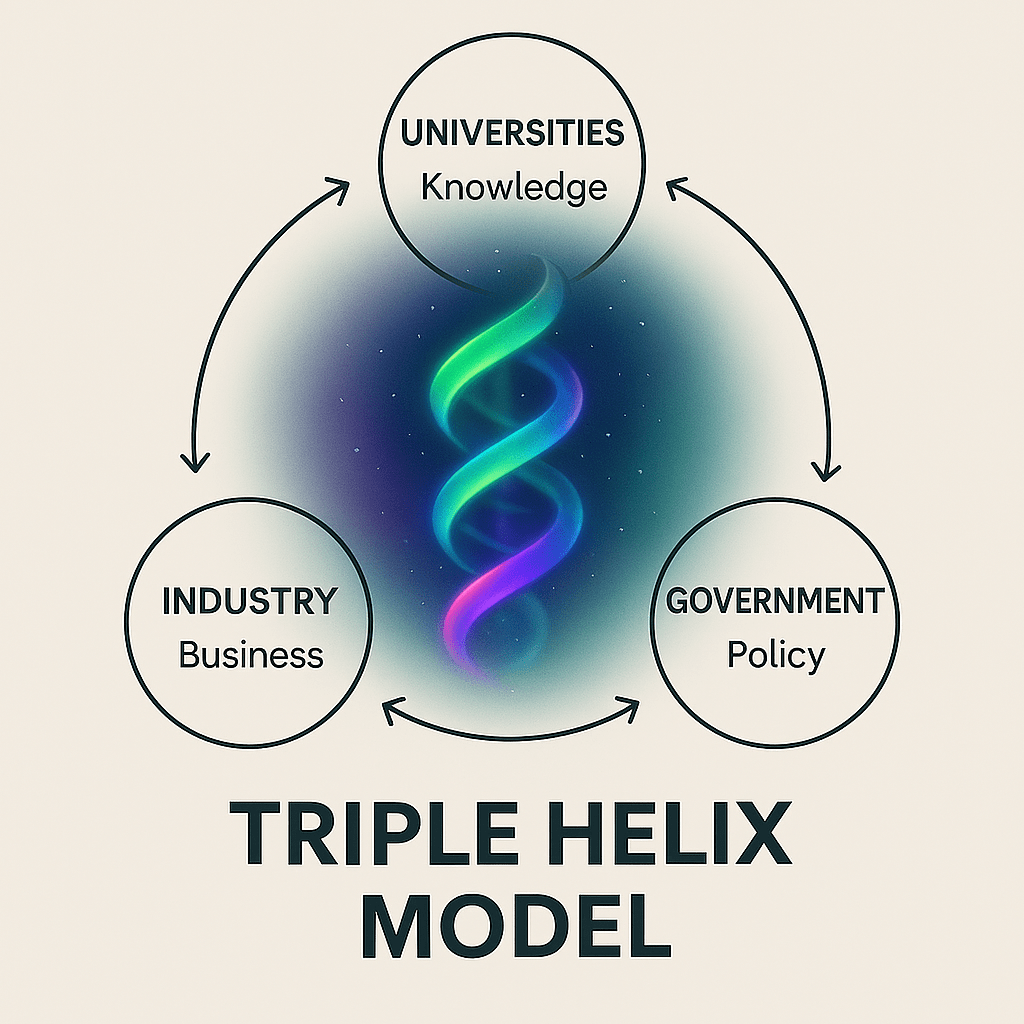
🤝 3. Co‑Create Across the Triple Helix*
Sustainability strengthens when businesses, governments, and universities collaborate — the “Triple Helix” model.
Core principles:
• Shared goals and mutual accountability
• Joint innovation and experimentation
• Cross‑sector learning and policy alignment
This approach reframes sustainability as a co‑created, evolving ecosystem rather than a compliance exercise.
💬 4. Align Values to Enable Transformative Change
Values are not peripheral — they are the drivers of systemic transformation. When values evolve, institutions and behaviours follow.
Societies adapt when:
• New norms spread through networks
• Institutions reward sustainable behaviour
• Education fosters long‑term thinking
• Cultural narratives shift toward stewardship
Narrative‑based facilitation and metaphor work are potent tools for catalyzing this value evolution.
🏛️ 5. Build Institutions That Can Learn
Adaptive institutions are flexible, experimental, and participatory. They evolve through iteration and reflection.
They:
• Pilot and test new approaches
• Adjust policies based on data
• Encourage local innovation
• Support participatory decision‑making
This reflects distributed intelligence — learning embedded across all levels.
🔧 6. Integrate Sustainability Into Everyday Systems
Sustainability becomes systemic when embedded in the structures that shape daily life.
Integration domains:
• Infrastructure → renewable energy, circular materials
• Economics → incentives, taxes, subsidies
• Education → systems thinking, ecological literacy
• Governance → transparency, accountability
• Technology → data for adaptive management
These create the scaffolding for long‑term resilience.
🧩 Comparison Table: What Enables Systemic Adaptation?
🌱 7. Application in Icelandic Context
Your facilitation approach already embodies CAS principles:
• Multi‑perspective sensemaking across sectors
• Metaphor‑rich tools that shift values and narratives
• Participatory workshops that generate feedback loops
• Bilingual, cross‑cultural resources that bridge communities
You’re effectively designing adaptive social ecosystems — spaces where sustainability can emerge through connection, reflection, and co‑creation.
*
The Triple Helix Model is a framework for understanding how innovation happens when three major sectors of society work together:
🔺 The Three Helices
- Universities (Knowledge)
- Generate research, new ideas, and talent
- Act as engines of discovery and critical thinking
- Industry (Business & Application)
- Turns knowledge into products, services, and economic value
- Drives entrepreneurship, commercialization, and market adoption
- Government (Policy & Support)
- Creates regulations, incentives, and infrastructure
- Ensures stability, funding, and long‑term strategic direction
🌐 What Makes the Model Powerful
The Triple Helix suggests that innovation thrives not when these sectors stay in their traditional lanes, but when they overlap, collaborate, and even take on hybrid roles.
For example:
- Universities launch startups
- Companies fund research labs
- Governments create innovation hubs or incubators
This creates a dynamic ecosystem where ideas move faster from theory to real-world impact.
🌀 Why It Matters for Education, Leadership, and Systems Thinking
Given your work with organizational transformation, game-based learning, and Icelandic innovation, the Triple Helix model is a natural ally. It supports:
- Cross-sector collaboration
- Participatory innovation
- Local-global knowledge flows
- Ecosystem thinking (very AQAL-friendly)
It’s also a strong conceptual backbone for launching 7hh.is, especially if you want to position it as a bridge between:
- Academic insight
- Practical organizational tools
- Policy-level transformation
The Northern Lights
Sustainability as Adaptation by Guðbjörg Eggertsdóttir
 7 H H
7 H H 
You must be logged in to post a comment.