How Society Can Strengthen Its Capacity to Adapt
Building an adaptive society requires both structural and cultural transformation — a balance between systems that support flexibility and people who embody resilience, empathy, and creativity. Adaptation is not a single action but a continuous process of learning, reflection, and renewal.
1. Cultivate Emotional and Social Intelligence
Adaptation begins with people. Societies thrive when individuals can manage emotions, empathize with others, and collaborate across differences.
- Integrate emotional intelligence and mindfulness into education.
- Encourage open dialogue about mental health and emotional well-being.
- Promote empathy-based leadership in communities and institutions.
2. Foster Lifelong Learning
A learning society adapts faster because it stays curious and open to change.
- Redesign education to emphasize creativity, problem-solving, and adaptability over rote knowledge.
- Support continuous learning through accessible online platforms and community programs.
- Encourage intergenerational learning — sharing wisdom between older and younger generations.
3. Strengthen Community Networks
Resilient societies are built on strong, connected communities.
- Invest in local initiatives that build trust and cooperation.
- Support volunteerism, civic engagement, and shared spaces for dialogue.
- Encourage collaboration between public, private, and nonprofit sectors to solve local challenges.
4. Build Flexible and Inclusive Systems
Institutions must evolve to respond quickly to new realities.
- Design policies that can adapt to emerging needs rather than rigidly enforcing outdated rules.
- Ensure inclusivity in decision-making so diverse voices shape solutions.
- Use data and feedback loops to continuously refine social programs and governance.
5. Embrace Sustainable and Regenerative Practices
Environmental adaptation is central to societal survival.
- Transition to renewable energy and circular economies.
- Support local food systems and sustainable urban design.
- Educate citizens about ecological responsibility and collective stewardship.
6. Encourage Ethical Technology Use
Technology should serve humanity, not dominate it.
- Promote digital literacy and critical thinking.
- Create ethical frameworks for AI, data privacy, and automation.
- Design technology that enhances connection, creativity, and well-being.
7. Nurture Cultural and Creative Expression
Art, storytelling, and culture help societies process change and imagine new futures.
- Support creative industries and cultural education.
- Use art as a medium for dialogue, healing, and social innovation.
- Celebrate diversity as a source of strength and inspiration.
8. Lead with Purpose and Compassion
Adaptive leadership is grounded in humility, empathy, and vision.
- Train leaders to listen deeply, act transparently, and empower others.
- Encourage collaboration over competition in politics, business, and education.
- Align societal goals with shared values — justice, sustainability, and human dignity.
In essence, we strengthen societal adaptation by combining emotional maturity, continuous learning, and collective responsibility. When individuals, communities, and institutions evolve together, they are guided by empathy and purpose. Society becomes not just adaptable but also truly regenerative.
Adapting Icelandic Society for a Flourishing Future
1. Environmental and Ecological Adaptation
Iceland’s natural environment is both its greatest asset and its most delicate responsibility. True adaptation means deepening the relationship between people and nature — not just protecting it, but co-evolving with it.
a. Regenerative Energy and Ecology
- Move beyond sustainability toward regeneration: restoring ecosystems, rewinding degraded lands, and protecting marine biodiversity.
- Develop community-owned energy cooperatives where citizens share in the benefits of geothermal and wind energy.
- Integrate ecological education into all levels of schooling, teaching children to see themselves as part of living systems.
b. Climate Resilience and Food Sovereignty
- Invest in geothermal greenhouses and vertical farming to guarantee food security as global supply chains shift.
- Support regenerative agriculture that rebuilds soil health and captures carbon.
- Create local food networks connecting farmers, fishers, and consumers to reduce dependence on imports.
2. Social Well-being and Collective Flourishing
Iceland’s small population and strong social fabric make it uniquely positioned to model a well-being-centered society. This society measures success not by GDP, but by collective thriving.
a. Mental and Emotional Health
- Embed mindfulness, Qi Gong, and compassion-based practices into public health programs and workplaces.
- Train leaders in emotional intelligence and presence, ensuring that decision-making is guided by empathy and clarity.
- Create community well-being centers that blend traditional healthcare with holistic approaches — movement, breath-work, and nature therapy.
b. Equality and Inclusion
- Deepen gender equality by addressing invisible biases and supporting shared care-giving models.
- Create intercultural dialogue programs that celebrate diversity and foster belonging for immigrants and refugees.
- Encourage inter-generational collaboration — elders sharing wisdom, youth bringing innovation.
3. Education and Conscious Innovation
Education can become the heart of Iceland’s adaptation — cultivating not only knowledge but wisdom.
a. Transformational Learning
- Shift from rote learning to experiential education: outdoor learning, creative problem-solving, and emotional literacy.
- Introduce mind-body-heart curricula that balance intellect with compassion and self-awareness.
- Encourage lifelong learning ecosystems — community hubs where people of all ages learn, teach, and co-create.
b. Innovation with Integrity
- Foster ethical technology development that aligns with human and ecological well-being.
- Support social entrepreneurship — ventures that solve societal challenges while sustaining livelihoods.
- Build innovation sanctuaries where artists, scientists, and spiritual practitioners collaborate on future visions.
4. Governance and Participatory Democracy
Iceland’s democratic culture can evolve into a model of conscious governance — transparent, inclusive, and guided by shared values.
a. Citizen Empowerment
- Expand citizen assemblies to deliberate on major national issues, blending wisdom from all walks of life.
- Use digital democracy platforms to make participation easy, transparent, and meaningful.
- Encourage local autonomy — municipalities designing solutions that show their unique landscapes and cultures.
b. Leadership as Service
- Redefine leadership as stewardship: leaders as facilitators of collective intelligence rather than power holders.
- Offer leadership retreats focused on mindfulness, compassion, and ethical decision-making.
- Create national well-being indicators to guide policy beyond economic growth.
5. Health, Lifestyle, and Connection to Nature
The Icelandic way of life is close to nature. It is community-oriented and resilient. This approach can be deepened into a conscious lifestyle model for the world.
a. Preventive and Integrative Health
- Combine modern medicine with traditional healing, movement, and breath-based practices.
- Promote daily well-being rituals — morning movement, mindful meals, time in nature.
- Encourage workplace well-being cultures that highlight rest, creativity, and human connection.
b. Nature as Teacher
- Design nature-based education and Eco-retreats that reconnect people with the land and sea.
- Protect sacred natural sites as spaces for reflection and renewal.
- Cultivate seasonal living — aligning work, rest, and celebration with the rhythms of Iceland’s light and darkness.
6. Cultural and Spiritual Renewal
Adaptation is not only structural — it’s also spiritual. Iceland’s sagas, poetry, and deep connection to the elements can guide a renewal of meaning.
a. Reviving Cultural Wisdom
- Reinterpret ancient Norse and Icelandic traditions through a modern lens of compassion and ecological awareness.
- Support artists, storytellers, and musicians who explore the intersection of heritage and future vision.
- Encourage rituals of gratitude and community that strengthen belonging and reverence for life.
b. A Global Beacon of Balance
- Position Iceland as a living laboratory for well-being, sustainability, and conscious leadership.
- Host international gatherings on climate, compassion, and creativity — sharing Iceland’s model with the world.
- Embody the principle of balance between mind, body, and heart as a national ethos.
Adapting Icelandic society in this way would not mean abandoning modern progress — it would mean evolving it. A society rooted in wisdom, compassion, and harmony with nature can become a guiding light for a world seeking balance.
Build Flexible and Inclusive Systems
For a society to adapt effectively, its systems must be designed for flexibility. They must also promote inclusion. Rigid structures struggle to respond to rapid change, while adaptive systems evolve through feedback, participation, and shared accountability.
Key ways to build flexible and inclusive systems:
- Adaptive governance: Policies should be living frameworks that can evolve as new information and challenges emerge. Governments and institutions can use pilot programs, iterative policy making, and real-time data to refine decisions.
- Inclusive participation: Diverse voices — across age, gender, culture, and socioeconomic background — must be part of decision-making. Inclusion ensures that solutions show the complexity of society and prevent marginalization.
- Collaborative problem-solving: Encourage partnerships between public institutions, private enterprises, and community organizations. Shared responsibility fosters innovation and resilience.
- Feedback and transparency: Systems that listen and respond to citizens’ experiences build trust. Open communication channels and transparent reporting help institutions adjust quickly when conditions change.
- Equity as a foundation: Flexibility must not come at the cost of fairness. Adaptive systems guarantee that resources, opportunities, and protections are distributed justly, especially during transitions or crises.
In essence, flexible and inclusive systems are living ecosystems — responsive, participatory, and grounded in equity. They allow societies to evolve gracefully, maintaining stability while embracing transformation.
See also adapting in the organization.
Adaptation in society refers to how individuals, groups, and institutions adjust their behaviors, norms, and structures. This adjustment helps them cope with social, cultural, and environmental changes. It’s the mechanism that allows communities to survive, evolve, and thrive in shifting circumstances.
🔑 Core Dimensions of Social Adaptation
- Cultural adaptation: Adjusting traditions, practices, and values to fit new realities (e.g., integrating digital culture into everyday life).
- Structural adaptation: Institutions like schools, governments, and corporations reorganize to meet emerging needs (e.g., remote work policies during the pandemic).
- Behavioral adaptation: Individuals change actions and habits to align with new social expectations (e.g., sustainability practices like recycling or reducing carbon footprints).
Sources: Sociology… +1
🧩 Theories of Social Adaptation
- Talcott Parsons’ AGIL framework: He argued that adaptation is one of four essential functions societies must fulfill. These functions are Adaptation, Goal-attainment, Integration, and Latency. In modern societies, the economy often acts as the subsystem that enables adaptation Sociology Plus.
- Socialization as a driver: Families, schools, peer groups, and media convey norms and values. These institutions equip individuals to adapt to new roles and environments sociology.
🌍 Examples of Adaptation in Contemporary Society
- Technological adaptation: Communities learning to integrate AI, digital platforms, and automation into daily life and work.
- Cultural adaptation in migration: Immigrant groups balancing heritage with integration into host societies.
- Climate adaptation: Cities redesigning infrastructure to withstand rising sea levels or extreme weather.
- Economic adaptation: Businesses shifting toward green energy or digital-first models to stay competitive.
⚖️ Challenges to Adaptation
- Resistance to change: Deeply rooted traditions or power structures can slow adaptation.
- Inequality: Not all groups have equal resources to adapt, leading to social tension.
- Consensus gaps: Different narratives about what “successful adaptation” looks like can hinder collective action Elgar online.
✨ Why It Matters
Adaptation in society is not just survival—it’s about resilience and transformation. A society that adapts well can turn crises into opportunities, foster inclusivity, and stay relevant in a rapidly changing world. For Iceland, for example, adaptation means blending local traditions with global innovation while maintaining cultural identity.
🌱 Ecosystems
- Show how diverse elements coexist and adapt together.
- Useful for illustrating resilience, interdependence, and systemic change.
🏙️ Evolving Cities
- Urban landscapes shifting with technology, sustainability, and migration.
- A metaphor for collective adaptation in society.
🔄 Spirals
- Represent ongoing cycles of adaptation rather than linear progress.
- Tie into Wilber’s developmental frameworks.
Game-Based Simulation (30 min)
- Setup: Divide participants into small groups. Each group stands for a “mini-society.”
- Challenge: Introduce sudden changes (e.g., new technology, migration, climate event).
- Task: Groups must adapt their “society rules” and roles to respond.
- Outcome: Embodied experience of adaptation pressures and creative responses.
Role-Play Perspectives (20 min)
- Activity: Assign roles (citizen, policymaker, entrepreneur, activist).
- Scenario: A city facing rapid digital transformation.
- Prompt: “How does your role adapt, and what tensions arise?”
- Outcome: Highlights diverse viewpoints and the need for integration.
Reflection Spiral (15 min)
- Visual Tool: Spiral diagram showing cycles of adaptation (shock → response → integration → transformation).
- Activity: Participants map where their organization now sits in the spiral.
- Outcome: Identifies readiness and resilience levels.
Closing Integration (15 min)
- Activity: Each participant writes one “adaptation commitment” on a metaphor card.
- Collective Ritual: Cards are placed together to form a symbolic ecosystem.
- Outcome: Shared vision of adaptation as a collective, ongoing process.
System thinking is a powerful lens for understanding adaptation in society. It helps us see beyond isolated events. It allows us to view the interconnected web of causes, feedback loops, and emergent patterns.
🔎 How Systems Thinking Illuminates Social Adaptation
Interconnection
- Society is not a set of separate parts but a network of relationships: economy, culture, environment, technology, governance.
- Adaptation happens when one part shifts and the ripple effects cascade through the whole system (e.g., digital reshaping education, work, and family life together).
Feedback Loops
- Positive feedback accelerates change (e.g., social media adoption → more users → more influence on norms).
- Negative feedback stabilizes systems (e.g., laws and regulations temper disruptive innovations).
- Adaptation is often about balancing these loops so society doesn’t spiral into chaos or stagnation.
Delays & Non-linearity
- Societal adaptation rarely happens instantly; there are delays between cause and effect.
- Example: Climate policies may take decades to show results, creating tension between short-term sacrifice and long-term resilience.
Emergence
- New behaviors, norms, or institutions emerge from collective interactions rather than top-down design.
- Migration, for instance, doesn’t just add people—it reshapes culture, language, and identity in ways no single actor controls.
Leverage Points
- Systems thinking identifies where small interventions can create big shifts.
- Example: Education reform can ripple into economic innovation, civic participation, and cultural resilience.
🌍 Applying Systems Thinking to Adaptation in Society
- Mapping systems: Use causal loop diagrams to visualize how technology, policy, and culture interact.
- Scenario planning: Explore how shocks (pandemics, climate events, AI disruption) ripple across subsystems.
- Whole-society resilience: Shift focus from fixing isolated problems to strengthening adaptive capacity across the network.
✨ Map adaptation as a system:
- Start with a central change (e.g., climate migration).
- Ask them to draw arrows showing impacts on housing, education, healthcare, culture, economy.
- Then find feedback loops and leverage points where interventions can accelerate positive adaptation.
This turns adaptation from an abstract idea into a living system map participants can interact with.
Sampler causal loop diagram (visual map) of societal adaptation—for example, how climate change drives adaptation across social subsystems?
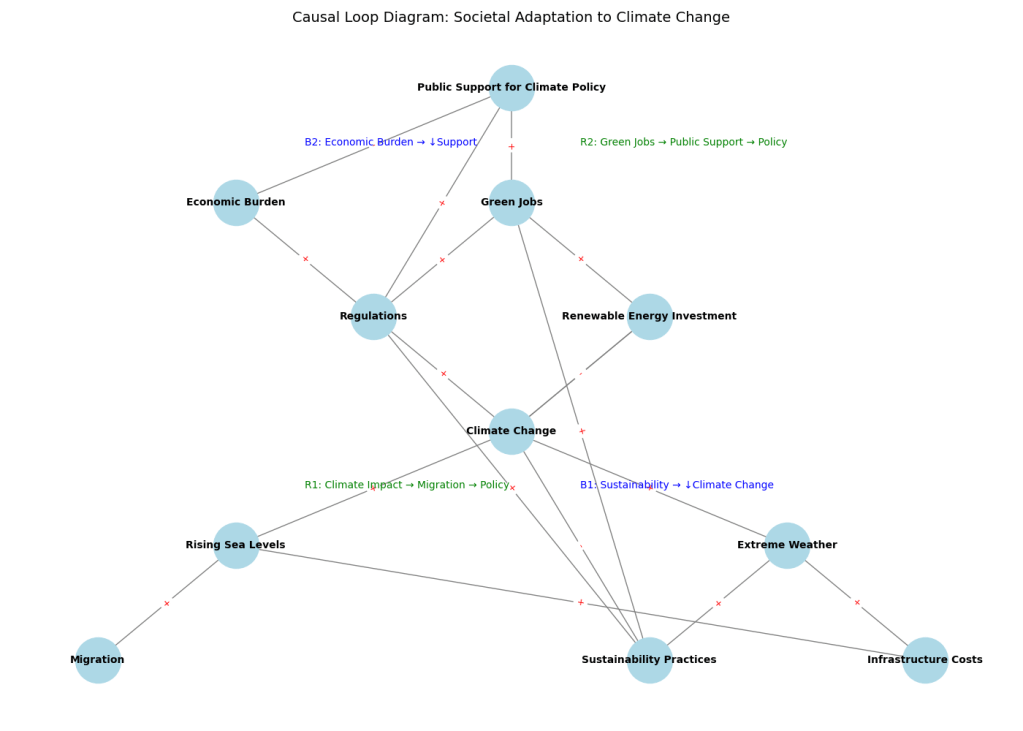
Here’s a causal loop diagram that shows how societies adapt to climate change, using systems thinking. It highlights reinforcing (R) and balancing (B) feedback loops.
🔎 How to Read This Diagram
- Climate Change Impacts lead to rising sea levels and extreme weather. These impacts trigger social behaviors like migration and sustainability practices. They also start policy responses including regulations and renewable energy investment.
- Economic Shifts (green jobs, infrastructure costs) emerge from these changes, feeding back into public support and adaptation capacity.
- Reinforcing Loops (R):• R1: Climate impacts → migration → policy → further adaptation.
- R2: Green jobs → public support → stronger policy → more adaptation.
- Balancing Loops (B):• B1: Sustainability practices and renewable energy reduce climate change impacts.
- B2: Economic burden from regulations can reduce public support, slowing adaptation.
🌍 Why Systems Thinking Matters
- Interconnection: Shows how climate, economy, and society are inseparable.
- Feedback Loops: Reveal why adaptation can accelerate (R loops) or stall (B loops).
- Delays & Unintended Consequences: Policies take decades to show results, while economic burdens can create resistance.
- Leverage Points: Investing in education, green jobs, and public awareness can strengthen positive loops and weaken negative ones.
✨ Invite participants to map their own adaptation system:
- Place a central challenge (e.g., digital disruption, migration).
- Draw arrows to show impacts across subsystems (economy, culture, governance).
- Find reinforcing and balancing loops.
- Discuss leverage points where small interventions create big shifts.
🌀 Workshop Activity: Build Your Own Causal Loop Map
Step 1. Introduce the Core Challenge
- Place a central theme on the board (e.g., climate migration, digital disruption, economic inequality).
- Explain that this is the “shock” or “pressure” the setup must adapt to.
Step 2. Recognize Subsystems
- Ask participants to brainstorm the main areas affected:• Economy (jobs, costs, innovation)
- Culture (identity, language, traditions)
- Governance (laws, policies, institutions)
- Environment (resources, resilience)
- Social behavior (norms, practices, movements)
Step 3. Draw Connections
- Use arrows to show cause-and-effect relationships.
- Example: Climate migration → housing demand → policy response → infrastructure investment → economic shifts.
Step 4. Spot Feedback Loops
- Highlight reinforcing loops (R): where change accelerates itself.• Green jobs → public support → stronger policy → more green jobs.
- Highlight balancing loops (B): where change stabilizes or resists.• High regulation costs → reduced public support → weaker policy.
Step 5. Discuss Delays & Emergence
- Note where effects take time (e.g., education reform → workforce skills decades later).
- Ask: “What new behaviors or institutions emerge from these interactions?”
Step 6. Leverage Points
- Invite participants to find small interventions with big impact.• Example: Investing in education strengthens resilience across economy, culture, and governance at the same time.
✨ By the end, participants will have a visual map of adaptation as a living system. This makes abstract concepts tangible and shows how society adapts through interconnected loops rather than isolated fixes.
AQAL by Ken Wilber
Using AQAL Integral Theory for Societal Adaptation
The AQAL framework (All Quadrants, All Levels, All Lines, All States, All Types), developed by Ken Wilber, offers a holistic lens for understanding and guiding adaptation in society. It helps integrate inner and outer dimensions of change—both individual and collective—so transformation becomes more balanced and sustainable.
1. All Quadrants: Mapping the Whole System
AQAL’s four quadrants—Interior Individual (UL), Exterior Individual (UR), Interior Collective (LL), and Exterior Collective (LR)—help ensure that adaptation efforts address every dimension of human and societal life.
- UL (Inner Individual – Mindset & Meaning):
Support personal reflection, mindfulness, and emotional intelligence to help individuals adapt internally to change. - UR (Outer Individual – Behavior & Skills):
Encourage learning new competencies, technologies, and habits that align with emerging societal needs. - LL (Inner Collective – Culture & Values):
Foster shared narratives, rituals, and cultural dialogues that make adaptation meaningful and inclusive. - LR (Outer Collective – Systems & Structures):
Redesign institutions, policies, and infrastructures to support adaptive capacity and resilience.
2. All Levels: Developmental Growth
Societal adaptation requires recognizing that individuals and groups operate from different stages of development—cognitive, moral, and cultural.
Policies and communication strategies can be tailored to meet people where they are, while gently inviting growth toward more complex, integrative perspectives.
3. All Lines: Multiple Intelligences
Adaptation isn’t only intellectual—it involves emotional, moral, interpersonal, and spiritual intelligences.
Programs that cultivate these diverse capacities create more flexible, compassionate, and creative societies.
4. All States: Accessing Awareness
Encouraging practices that expand awareness—such as mindfulness, art, or nature immersion—helps people experience interconnectedness and reduces fear-based resistance to change.
5. All Types: Embracing Diversity
Different personality types, genders, and cultural archetypes bring unique strengths to adaptation.
An integral approach values this diversity as essential to collective resilience.
Practical Application
- Education: Integrate AQAL-informed curricula that balance inner development with outer skill-building.
- Leadership: Train leaders to see through all quadrants, aligning personal integrity, team culture, and systemic design.
- Community Development: Use AQAL mapping to identify where adaptation is blocked—whether in mindset, behavior, culture, or structure—and design interventions accordingly.
- Policy Design: Craft adaptive policies that consider both measurable outcomes (UR/LR) and qualitative shifts in meaning and belonging (UL/LL).
In essence: AQAL helps societies adapt not just by changing systems, but by evolving consciousness—aligning mind, behavior, culture, and structure into a coherent, living whole.
Presentation – AQAL Integral Theory by Guðbjörg Eggertsdóttir
Workshop
🎯 1. Quadrant Walk: Embodied Perspectives
Setup: Place large quadrant posters or floor mats in a room. Each corner symbolizes one AQAL quadrant.
Flow:
- Participants walk to the quadrant that resonates most with a prompt (e.g., “Where does your organization resist change?”).
- In each quadrant, they show using cards or questions:• UL: “What beliefs are shifting in you?”
- UR: “What new behaviors are emerging?”
- LL: “What stories are we telling?”
- LR: “What systems are evolving?”
🧩 AQAL Puzzle Challenge
Setup: Teams get a puzzle board with four quadrant slots and a deck of cards (values, behaviors, cultures, systems).
Flow:
- Teams must match cards to quadrants and explain their reasoning.
- Bonus rounds: Add “Levels,” “Lines,” or “States” cards to layer complexity.
- Use bilingual prompts to localize the game (e.g., Icelandic cultural metaphors vs global innovation metaphors).
Goal: Build a coherent adaptation strategy using all quadrants.
🗣️ 3. Metaphor Roleplay: AQAL Personas
Setup: Assign each participant a quadrant-based persona:
- UL: The Inner Seeker
- UR: The Tech Adapter
- LL: The Cultural Weaver
- LR: The System Architect
Flow:
- Introduce a societal challenge (e.g., climate migration, AI ethics).
- Each persona shares their quadrant’s view.
- Together, they co-create a holistic response.
Bonus: Use costume props or symbolic objects (e.g., heart stone, gear, story scroll, blueprint) to embody roles.
🎴 AQAL Champagne Launch Cards
🍷 Toast Card (UL – Interior Individual)
- Icon: A raised glass with a heart inside.
- Prompt (EN): What inner spark guides your adaptation?
- Prompt (IS): Hvaða innri neisti leiðir þig í aðlögun?
🫧 Bubble Card (UR – Exterior Individual)
- Icon: Rising bubbles with a gear.
- Prompt (EN): What new behavior or skill is bubbling up in you?
- Prompt (IS): Hvaða ný hegðun eða færni er að koma fram hjá þér?
🎉 Celebration Card (LL – Interior Collective)
- Icon: A group of people clinking glasses.
- Prompt (EN): What story or ritual reflects our collective adaptation?
- Prompt (IS): Hvaða saga eða helgiathöfn endurspeglar sameiginlega aðlögun okkar?
🍾 Bottle Card (LR – Exterior Collective)
- Icon: A champagne bottle with a city skyline inside.
- Prompt (EN): What system or structure holds and supports our change?
- Prompt (IS): Hvaða kerfi eða uppbygging heldur og styður breytinguna okkar?
🧨 Cork Card (Integration)
- Icon: A cork popping free.
- Prompt (EN): What resistance must we release to flow forward?
- Prompt (IS): Hvaða mótstöðu þurfum við að sleppa til að flæða áfram?
⏱ Timing Overview (90 minutes total)
- Welcome & Orientation – 10 min
- Quadrant Rounds (Toast, Bubble, Celebration, Bottle) – 15 min each (60 min)
- Cork Release & Integration – 10 min
- Final Toast & Closing – 10 min
🥂 Step 1: Welcome & Orientation
- Introduce the AQAL Champagne Game as a playful lens for adaptation.
- Hand out bilingual cards (EN/IS) to each participant.
- Explain the metaphors: Toast = values, Bubble = behaviors, Celebration = culture, Bottle = systems, Cork = resistance.
🍷 Step 2: Toast Round (UL – Interior Individual)
- Prompt: “What inner spark guides your adaptation?” / „Hvaða innri neisti leiðir þig í aðlögun?“
- Each participant writes on their Toast Card and shares aloud.
- Facilitator collects key words on a board (visual anchor).
🫧 Step 3: Bubble Round (UR – Exterior Individual)
- Prompt: “What new behavior or skill is bubbling up in you?” / „Hvaða ný hegðun eða færni er að springa fram hjá þér?“
- Participants act out or describe their “bubble.”
- Optional: blow soap bubbles or project digital bubble icons for atmosphere.
🎉 Step 4: Celebration Round (LL – Interior Collective)
- Prompt: “What story or ritual reflects our collective adaptation?” / „Hvaða saga eða helgiathöfn endurspeglar sameiginlega aðlögun okkar?“
- Small groups co-create a short bilingual chant, story, or ritual.
- Share back to the whole group in a circle.
🍾 Step 5: Bottle Round (LR – Exterior Collective)
- Prompt: “What system or structure holds and supports our change?” / „Hvaða kerfi eða uppbygging styður breytinguna okkar?“
- Teams sketch bottle-shaped diagrams in Canva/Miro.
- Each “bottle” represents a supportive system (education, policy, tech).
🧨 Step 6: Cork Release (Integration)
- Prompt: “What resistance must we release to flow forward?” / „Hvaða mótstöðu þurfum við að sleppa til að flæða áfram?“
- Each group identifies one cork (resistance point).
- Symbolically “pop” corks (real or metaphorical) with a cheer.
🥂 Step 7: Final Toast & Closing
- Everyone raises a glass (champagne, sparkling water, or symbolic gesture).
- Each participant names one bilingual intention for societal transformation.
Workshop Game: “The Flow of Change”
AQAL-Inspired Adaptation Game for Leaders
Purpose
To help leaders experience how personal, cultural, and systemic dimensions of change interact—using the Toast, Bubble, Celebration, Bottle, and Cork cards as metaphors for adaptation.
Setup
- Participants: 10–30 (divided into small groups of 4–6)
- Materials: Printed or digital bilingual cards (Icelandic/English), sticky notes, markers, timer, and a large shared board (physical or digital in Canva or Miro).
- Duration: 60–90 minutes
Game Flow
1. Opening Circle (10 min)
Facilitator introduces the AQAL model and the five cards:
- Toast (UL): Inner beliefs and values
- Bubble (UR): Visible actions and skills
- Celebration (LL): Shared culture and stories
- Bottle (LR): Systems and structures
- Cork (Integration): Resistance and release
Each participant chooses one card that resonates with their current leadership challenge.
2. Mapping the Challenge (15 min)
Groups share their chosen cards and map their challenges on a four-quadrant board:
- What’s happening inside individuals (UL)?
- What’s visible in behaviors (UR)?
- What’s shifting in culture (LL)?
- What’s changing in systems (LR)?
They use sticky notes or digital notes to fill in each quadrant.
3. The Flow Round (20 min)
Each group draws a random card from the deck and answers its bilingual prompt.
Example:
- Toast: “What belief needs to evolve for this change to take root?”
- Bubble: “What new behavior signals adaptation?”
- Celebration: “What story can unite people around this shift?”
- Bottle: “What structure supports or blocks progress?”
- Cork: “What can we release to move forward?”
Groups discuss and record insights, connecting them across quadrants.
4. Integration Round (15 min)
Each group uses the Cork Card to identify one resistance point and one release action.
They then design a short “ritual of release” (a symbolic gesture, phrase, or movement) to represent letting go of what no longer serves.
5. Collective Reflection (10–15 min)
Groups share their rituals and insights.
Facilitator highlights patterns across quadrants—how inner shifts, behaviors, culture, and systems interrelate.
Outcome
Participants leave with:
- A visual map of their adaptive challenge
- A shared language for discussing change
- A felt sense of integration between personal, cultural, and systemic dimensions
Optional Digital Extension
- Create a Canva board with bilingual card templates and quadrant layout for hybrid or online workshops.
- Animate the cards for social media storytelling.
Improving Mental Health in the Workplace — A Deeper Approach
1. Build a Culture of Psychological Safety
True psychological safety goes beyond open-door policies. It’s about cultivating trust at every level. Leaders can model vulnerability by sharing their own challenges and how they manage stress. Regular “pulse check” meetings—where employees can speak freely about workload, team dynamics, or emotional strain—help normalize honest dialogue. When people feel heard, they’re more likely to engage and less likely to burn out.
2. Redefine Success and Productivity
Many workplaces equate productivity with constant activity. Shifting the narrative toward sustainable performance—where rest, reflection, and creativity are valued—creates a healthier rhythm. Encourage teams to set boundaries around availability, such as no-meeting days or digital detox hours. This helps employees recharge and return with clarity and focus.
3. Train Leaders as Well-being Stewards
Leadership training should include emotional intelligence, mindfulness, and compassionate communication. A leader who can recognize subtle signs of stress—withdrawal, irritability, or fatigue—can intervene early. Encourage leaders to ask, “How are you, really?” and to listen without rushing to fix. Compassionate leadership fosters loyalty and psychological resilience across teams.
4. Integrate Mind-Body Practices
Incorporating practices like Qi Gong, mindfulness, or breath-work into the workday helps regulate the nervous system. These practices reduce cortisol levels, improve focus, and enhance emotional balance. Even five minutes of mindful breathing before meetings can shift the collective energy of a team. When the body is calm, the mind follows.
5. Design Workflows That Support Mental Energy
Mental health is deeply tied to how work is structured. Encourage deep work periods—uninterrupted time for focus—balanced with recovery breaks. Avoid glorifying multitasking; instead, promote single-tasking and mindful transitions between tasks. This rhythm mirrors natural energy cycles and prevents cognitive overload.
6. Strengthen Social Connection and Belonging
Humans thrive in connection. Create rituals that foster community—shared lunches, gratitude circles, or storytelling sessions where employees share personal values or experiences. These deepen empathy and remind everyone that they’re part of something larger than their individual roles.
7. Offer Accessible, Stigma-Free Support
Normalize mental health conversations by integrating them into everyday dialogue. Offer confidential counseling, peer support networks, and mental health days. When leaders openly discuss therapy or self-care, it signals that seeking help is a strength, not a weakness.
8. Align Organizational Purpose with Human Values
A sense of meaning is a powerful buffer against stress. When employees understand how their work contributes to a greater purpose—whether it’s community impact, innovation, or sustainability—they experience deeper fulfillment. Aligning company goals with human values nurtures intrinsic motivation and emotional well-being.
9. Create Restorative Physical and Digital Environments
Design spaces that invite calm—natural light, plants, quiet zones, and art that inspires reflection. In digital spaces, reduce noise by setting clear communication norms (e.g., no after-hours emails). A serene environment signals that well-being is part of the organization’s DNA.
10. Measure and Evolve Well-being Practices
Mental health strategies should evolve with the organization. Use anonymous surveys, focus groups, and well-being metrics (like engagement, absenteeism, or turnover) to assess impact. Treat well-being as a living system—one that requires continuous listening, learning, and adaptation.
When mental health becomes a shared responsibility—woven into leadership, culture, and daily practice—the workplace transforms into a space where people can thrive, not just survive.
 7 H H
7 H H 
You must be logged in to post a comment.