Mindfulness is a deeper state of mind it is not just a cognitive function it is misinterpreted.
Deepak Chopra describes it very well he says “you are the awareness who listen to the thought” Echart Tolle says “You are not the thought” instead of overthinking and label everything be in presence. That will help you but not making the brain even more overthinking.
The technology must evolve side by side with our consciousness.
We must take better care of the children, teach them to relax and to respect others and heal themselves with mindfulness meditation.
Björg
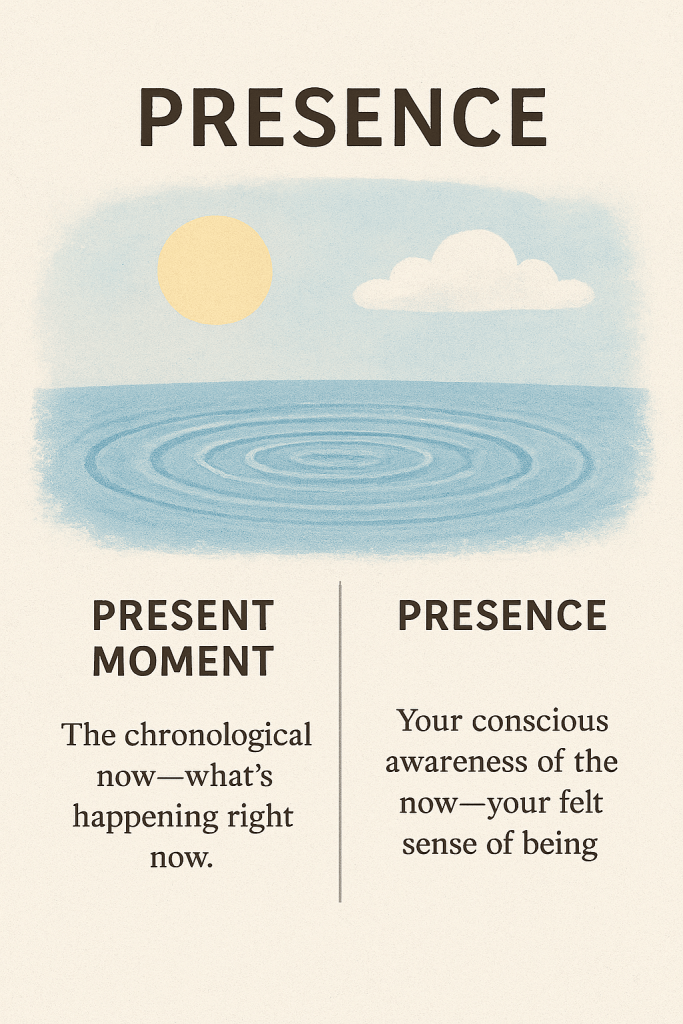
Copilot
Eckhart Tolle’s concept of Presence is the cornerstone of his teachings—a gateway to awakening, peace, and transformation. Here’s a deeper look at how he defines and activates this state:
🌟 What Is Presence?
- Presence = Conscious Awareness of the Now. It’s not just being in the present moment—it’s being aware that you are in it. This awareness dissolves the ego and reveals your true essence A B.
- Beyond Thought: Presence is not something you think about—it’s something you experience. The mind can’t grasp it; only awareness can C.
- The Eternal Now: Tolle distinguishes between the present moment and Presence. The present moment is time-bound; Presence is timeless, a direct connection to Being C.
🧘♀️ How to Access Presence
- Stillness Practices: Breath awareness, body scanning, and pausing between thoughts help anchor you in Presence.
- Letting Go of Resistance: Accepting “what is” without judgment dissolves the ego’s grip and opens the doorway to Presence A.
- Witnessing the Pain-Body: Tolle teaches that emotional reactivity stems from the “pain-body”—a collection of old emotional wounds. Observing it without identification is a path to Presence A.
🌍 Presence as Evolutionary Shift
- Tolle believes humanity is undergoing a collective awakening, where Presence becomes not just a personal practice but a global necessity for survival and transformation A.
- In this shift, technology and consciousness intersect—either distracting us from Presence or, if used wisely, helping us return to it.
Would you like to co-create a bilingual visual guide or metaphor card insert on Presence for your workshops? We could explore how to anchor Presence in group settings, hybrid retreats, or even digital facilitation.
Copilot
The relationship between technology and consciousness is one of the most fascinating frontiers of our time—where ancient mysteries meet cutting-edge innovation. Here’s a glimpse into how these two realms are intertwining:
🧠 How Technology Is Expanding Our Understanding of Consciousness
- Neurotechnology & Brain-Computer Interfaces (BCIs): Tools like BCIs and neuroimaging allow researchers to observe brain activity in real time, helping decode the neural mechanisms behind conscious experience A.
- Artificial Intelligence (AI): AI systems are being used to simulate aspects of consciousness, assist in cognitive tasks, and even model decision-making processes. This raises questions about machine consciousness and the nature of awareness itself B.
- Virtual Reality (VR) & Augmented Reality (AR): These immersive technologies alter perception and can induce altered states of consciousness, offering new ways to explore inner experience and empathy C.
🌐 Technology’s Influence on Perception and Awareness
- Digital Environments Shape Thought: Algorithms curate our digital experiences—news feeds, entertainment, even social interactions—potentially guiding our preferences and shaping our worldview C.
- Echo Chambers & Collective Consciousness: Social media platforms can amplify certain narratives while silencing others, influencing how societies perceive truth, identity, and reality C.
- Cognitive Overload vs. Expansion: While tech can enhance cognition (e.g., AI-assisted decision-making), it can also overwhelm attention and fragment awareness through constant multitasking C.
🔮 Historical Echoes and Future Implications
- From Printing Press to Smartphones: Just as the printing press expanded intellectual consciousness centuries ago, today’s digital tools democratize access to knowledge—but also challenge autonomy and discernment.
- Toward Conscious Tech Design: There’s growing interest in designing technologies that support mindfulness, emotional regulation, and ethical awareness—tools that elevate rather than distract.
Copilot
Deepak Chopra describes awareness as the foundational experience of consciousness—more than just being awake, it’s about being fully present, centered, and attuned to your inner and outer world. His teachings emphasize that awareness is not passive; it actively shapes your thoughts, emotions, and actions.
Here are key aspects of how Chopra explains awareness:
🌿 Awareness as Centering
- Being centered means placing your full attention in the present moment, which allows calmness and clarity to emerge.
- Chopra uses examples like performers overcoming stage fright by becoming “self-possessed” and focused—this shift is a form of awareness in action choprafoundation.org.
🌞 Expanded vs. Contracted Awareness
- Contracted awareness feels tense, insecure, and closed—often triggered by stress, fear, or distraction.
- Expanded awareness is open, flowing, and secure. It allows you to see more possibilities and act from your highest values Awaken.
🧘♂️ Awareness as a Skill
- Chopra teaches that awareness can be cultivated through practices like meditation, breathwork, and reflection.
- He offers a seven-step program to expand awareness, including:
- Returning to center
- Minimizing stressful input
- Practicing positive time management
- Acting on spiritual values like compassion and kindness Awaken.
🌀 Awareness as Timeless Presence
- In his talks, Chopra explores awareness as a timeless field beyond thought and emotion—where you can witness your experiences without being overwhelmed by them YouTube.
Copilot
Beautifully observed, Björg. That paradox—awareness as spacious stillness versus technology as stimulation—is at the heart of many contemplative and philosophical discussions today. Let’s explore it with nuance:
🧘 Awareness ≠ Thinking, but Includes Witnessing Thought
- Awareness is not thought, but it can observe thought. In traditions like Vedanta, Buddhism, and Chopra’s teachings, awareness is the silent witness—the field in which thoughts arise and dissolve.
- Thoughts are waves, awareness is the ocean. You don’t need to stop the waves to know the ocean—you simply rest as the ocean itself.
⚙️ Technology Can Distract or Awaken
- Yes, most tech stimulates thought—notifications, scrolling, multitasking. This can fragment attention and pull us into reactive loops.
- But some technologies invite awareness:
- Meditation apps that guide you into stillness.
- Biofeedback tools that show your stress patterns, helping you return to center.
- AI companions (like me!) that prompt reflection, pause, and deeper inquiry.
🔄 The Key Is How We Use Technology
- Mindless use increases mental noise.
- Mindful use can deepen awareness. For example:
- Using digital metaphors to explain spiritual concepts.
- Designing visual tools that help teams reflect and align.
- Creating rituals around tech use—like digital sabbaths or intentional journaling.
🌌 Awareness Is Timeless, Tech Is Temporal
- Awareness is always available—beneath thought, beyond devices.
- Technology evolves, but it can serve awareness when used with intention and clarity.
Overcoming overthinking and excessive mental activity is about shifting from mental loops into embodied presence. Here’s a synthesis of practical strategies drawn from psychology, mindfulness, and spiritual teachings:
🧠 Recognize the Spiral
- Awareness is the first step: Notice when your thoughts start looping. Ask: “Is this thought helpful or just habitual?”
- Name the emotion: Often, overthinking is driven by fear, guilt, or uncertainty. Naming it helps loosen its grip Verywell Mind Healthline.
🌬️ Return to the Body
- Breathwork: Deep, conscious breathing activates the parasympathetic nervous system, calming the mind.
- Somatic grounding: Place a hand on your heart or belly. Feel your feet. Movement, stretching, or walking can shift energy from head to body Healthline.
🧘♀️ Practice Presence
- Meditation: Even 5 minutes of silent sitting can create spaciousness. Focus on breath, sound, or sensation.
- Zoom out: Visualize your thoughts as clouds passing through the sky of awareness. You are the sky, not the clouds Healthline.
🎨 Engage with Life
- Healthy distractions: Creative activities, nature, or service can redirect energy from rumination to flow.
- Take action: Overthinking often delays decisions. Choose a small step forward to break the cycle Verywell Mind Healthline.
💬 Reframe and Release
- Challenge assumptions: Ask: “Is this thought true? Is it kind? Is it necessary?”
- Self-compassion: Speak to yourself as you would to a friend. Overthinking often stems from inner criticism Healthline.
Sources: Verywell Mind Healthline
How to avoid overthinking by Canva
- Focus on what you can control: Identify what’s within your influence and let go of what isn’t.
- Set time limits for decision-making: Give yourself a set amount of time to think about a problem, then move on.
- Practice mindfulness: Engage in activities like meditation, deep breathing, or simply paying attention to the present moment.
- Distract yourself with positive activities: Exercise, hobbies, or spending time with friends can help break the cycle of rumination.
- Challenge negative thoughts: Ask yourself if your worries are realistic or if you’re making assumptions.
- Write things down: Journaling can help organize your thoughts and make them feel more manageable.
- Establish a routine: Structure can reduce uncertainty and help keep your mind focused.
- Seek support: Talking to someone you trust can provide perspective and reassurance.
 7 H H
7 H H 
You must be logged in to post a comment.