Copilot
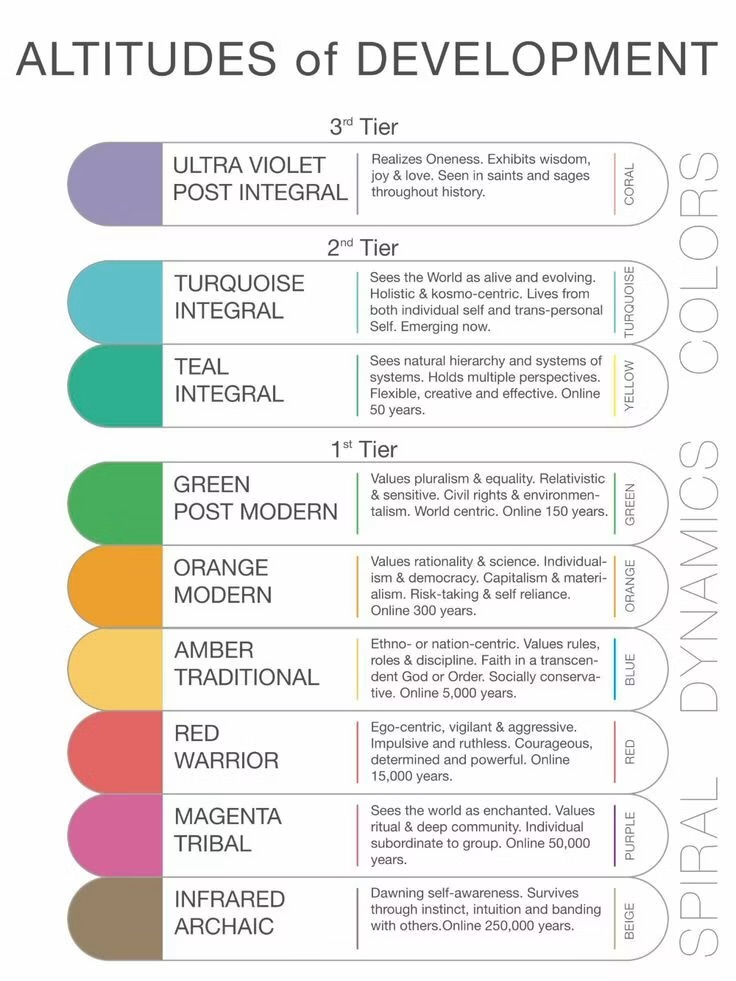
🧠 The shift from egocentric to world-centric cognitive intelligence reflects a profound evolution in how we perceive ourselves in relation to others and the world. This concept is often explored in developmental psychology, spiritual growth, and integral theory—especially in the work of thinkers like Ken Wilber.
🧩 What Do These Terms Mean?
Stage Description
Egocentric Focused on self; sees the world primarily through personal needs and views.
Ethnocentric Identifies with a group (family, tribe, nation); values others based on group membership.
World-centric Recognizes the inherent value of all people and life, regardless of affiliation.
📚 Cognitive Development Pathway
Ken Wilber and other developmental theorists describe this progression as part of “growing up”—the maturation of our worldview and moral reasoning:
- Egocentric: “Me first.” Common in early childhood and sometimes persists into adulthood as cognitive distortion A.
- Ethnocentric: “Us vs. Them.” Loyalty to one’s group, often seen in adolescence or early adulthood.
- World-centric: “We’re all in this together.” Embraces global empathy, systems thinking, and universal ethics.
This mirrors the development of multiple intelligences—like emotional, moral, and interpersonal intelligence—not just IQ B.
🧘 How to Cultivate World-Centric Intelligence
- Practice perspective-taking: Try to understand others’ experiences without judgment.
- Engage in global issues: Learn about cultures, social justice, and environmental challenges.
- Reflect on biases: Notice when your thinking is shaped by personal or group identity.
- Meditation & mindfulness: These practices help dissolve rigid self-identification and expand awareness.
Would you like a visual map of these stages or a journaling prompt to explore where you are on this spectrum?
Absolutely 🌍—cultivating world-centric intelligence is about moving beyond narrow self-interest and embracing a sense of shared humanity and interconnection with all life. Here are more examples across different areas of life that can spark this shift:
💬 Interpersonal Practices
- Listen to understand, not to reply: Be curious about others’ experiences—especially those different from your own.
- Avoid “othering” language: Speak in ways that honor the dignity and worth of all people.
- Support inclusive spaces: Whether at work, school, or online, advocate for environments that celebrate diversity.
🌿 Lifestyle and Consumption
- Make conscious choices: Support fair trade, sustainable brands, and companies that prioritize ethical labor and environmental care.
- Reduce waste: Compost, recycle, reuse—live with planetary stewardship in mind.
- Eat with awareness: Consider where your food comes from and who was impacted in its journey to you.
🧘 Inner Work and Reflection
- Practice global empathy: During meditation or journaling, reflect on someone in a distant part of the world—what they might be feeling, needing, or hoping for.
- Challenge your assumptions: When you feel resistance to unfamiliar ideas, pause and ask: “What worldview am I defending?”
- Read widely: Explore books by authors from different cultures, traditions, and perspectives.
📣 Social and Civic Engagement
- Volunteer for global causes: Help with refugee support, global health initiatives, or climate action.
- Engage in constructive dialogue: Discuss global issues with open-heartedness—even when opinions differ.
- Participate in cross-cultural experiences: Travel not just to see, but to connect. Or join international exchanges online.
World-centric intelligence is a mindset and a muscle—it grows through consistent practice and conscious choices. 🌱
Would you like help designing a weekly “World-Centric Challenge” plan to stretch your perspective and deepen your empathy day by day?
Fantastic! Here’s a simple and uplifting World-Centric Challenge Plan you can use over the next week to stretch your empathy, awareness, and sense of connection with the wider world 🌍. Each day has a theme and action designed to help shift perspective and deepen understanding:
🌏 7-Day World-Centric Challenge
Day 1 – Perspective Swap
🔍 Action: Choose a news story or issue from another country. Research it from local sources if possible.
💡 Reflection: What surprised you? How does it shift your view of global interconnectedness?
Day 2 – Conscious Consumption
🍽️ Action: Review what you buy, eat, or wear. Choose one item to swap for a more ethical or sustainable version.
💡 Reflection: What impact might this shift have—on people, animals, or the planet?
Day 3 – Radical Listening
👂 Action: Have a conversation with someone from a different background. Focus solely on understanding, not responding.
💡 Reflection: How did it feel to give your full presence? What assumptions were challenged?
Day 4 – Inner Reflection
🧘 Action: During meditation or journaling, picture someone across the world—perhaps a child, worker, or refugee.
💡 Reflection: What emotions arise as you imagine their reality? Can you send them compassion mentally?
Day 5 – Service Day
🤝 Action: Give time to a cause that supports people beyond your immediate community—online or locally.
💡 Reflection: How does contributing to something larger shift your sense of self?
Day 6 – Learn Widely
📚 Action: Read a chapter or article by a writer from a culture or worldview different than your own.
💡 Reflection: What new lens does this offer on life, values, or relationships?
Day 7 – Planetary Pause
🌱 Action: Spend time in nature or in stillness. Contemplate your role not just as a human—but as part of the Earth’s ecosystem.
💡 Reflection: What gratitude or responsibility do you feel toward life itself?
Would you like me to turn this into a printable guide or a shareable version for social media? Or we could design a version that recurs weekly with new rotating prompts. Let’s keep the momentum going 🌟
Where are you on this path to wholeness?
The progression from an egocentric to a world-centric worldview typically follows a series of transformative stages. These aren’t rigid steps, but rather fluid shifts in awareness and identity. Here’s a general framework inspired by developmental psychology, moral evolution, and integral theory:
🌱 1. Egocentric Stage — “Me”
- Primary focus: Self-preservation, immediate needs, personal gain
- Perspective: Sees the world as revolving around oneself
- Typical traits: Self-interest, minimal empathy for others
- Common in: Early childhood, or in adults under stress or trauma
🧍 2. Ethnocentric Stage — “Us”
- Primary focus: Loyalty to one’s group — family, tribe, religion, nation
- Perspective: Others outside the group are “different” or even threatening
- Traits: Conformity, pride in culture, possible exclusion of outsiders
- Common in: Adolescence, nationalist movements, traditional societies
🤝 3. Pluralistic Stage — “Everyone matters”
- Primary focus: Inclusion, social justice, equity across groups
- Perspective: Seeks understanding and harmony between diverse people
- Traits: Empathy, relativism, emotional intelligence
- Common in: Progressive communities, higher education settings
🌍 4. World-centric Stage — “All beings”
- Primary focus: Global welfare, human rights, environmental stewardship
- Perspective: Embraces diversity as a strength, transcends borders
- Traits: Systems thinking, ecological awareness, global compassion
- Common in: Global activists, humanitarian thinkers
✨ 5. Integral Stage — “Interconnected whole”
- Primary focus: Synthesizing multiple perspectives, personal growth and collective transformation
- Perspective: Recognizes both difference and unity, inner and outer development
- Traits: Holistic thinking, meta-awareness, spiritual insight
- Common in: Visionary leaders, philosophers, evolved consciousness frameworks
These stages aren’t a ladder to climb in one direction—people can move back and forth, or embody aspects of multiple stages at once. Kind of like having different lenses you can switch between, depending on the situation.
Do any of these stages resonate with you, Björg? Or spark reflections from your own worldview journey? 🌌
 7 H H
7 H H 